Mr Debney made a fascinating presentation. Smith and Wesson, a company that is over 160 years old, has now become a growth company. In their latest quarter they announced sales that were up 38% year over year http://ir.smith-wesson.com/phoenix.zhtml?c=90977&p=irol-newsArticle&ID=1792505&highlight=. They are an American company based in Springfield, MA. They are highly profitable and will steadily reduce debt this year. They also raised guidance for the full year of 2013.
Smith is Wesson is a legendary iconic American brand. They have products that were designed in the 1890's that are still selling today. How many companies could say the same?
Gun retailers in the USA have been compelled to reduce hours of operation and cut back on opening hours. They simply do not want to disappoint customers for whom they are not able to keep inventory in stock. Ammunition makers such as Olin are under similar pressures. There are many first-time gun owners. More women are buying guns than ever before.
Regardless of where you stand on the gun spectrum -- from gun nut to gun control nut or something in between (me) -- these are inescapable facts.
President Obama: Gun Salesman Extraordinaire
Now it is time to give credit where credit is due. Instead of leading on issues that affect our kids safety, (see earlier post Strategic Thoughts on Sandy Hook, 1/22/13) our President had issued a variety of Executive orders increasing the scope of gun control. Who would have thought that President Obama would turn out to be the greatest gun salesman of all time? No word yet on whether Smith and Wesson will be commissioning a life size bronze statue of Barrack Obama for the square in downtown Springfield...?
Seattle's own Macklemore Entertained at the Roth conference
John Fabian Witt's book Lincoln's Code: The Laws of War in American History (Free Press, 2012, www.amzn.com/1416569839) was recently honored with a well-deserved Bancroft prize. Witt's book is a profound meditation upon the nature of warfare from the perspective of American legal and military history. John Fabian Witt is a professor at Yale Law School and at the Yale History Department.
The United States of America has a long and complicated relationship with warfare. Some historians have, for example, interpreted American history as a being primarily a series of wars and invasions. European settlers fought a long series of wars against the native American peoples (from King Philip's war in Massachusetts to Little Big Horn in Montana) as a burgeoning land-hungry American population spread westwards to the Pacific. The French and later British attempted to manipulate the native Americans in order to thwart the expansion of the American colonies and later nation. Jefferson, a product of the Enlightenment, wrote that "the known rule of warfare with the Indian savages is an indiscriminate butchery of men women and children."
Cynics suggest, with some credibility, that America was won by a combination of warfare and shrewd deal-making. American Patriots or Rebels, depending on one's perspective, fought a war against their mother country, England, to win the independence of the 13 colonies. After the Revolution, Washington and Federalists tried to steer a course of neutrality. Yet President Madison led America into a nearly disastrous war for the rights of neutrals in the war of 1812 (see earlier posts War of 1812 4/1/12 and James Madison's USA and Hideki Tojo's Japan, 7/9/12). The Louisiana territory was purchased by Jefferson from Napoleon in 1803 for $15 million dollars (see earlier post Napoleon...Relevant to Americans in 2012?, 5/28/12). The deed was ratified in blood with the War of 1812. The Mexican-American war, led by President Polk, won the territory that would later become the states of California, Arizona, New Mexico and Texas. Alaska was purchased from Tsarist Russia. The Northwest territory (Washington, Oregon, etc.) was negotiated with Britain. The Hawaiian or Sandwich islands were conquered first by American missionaries and then by American arms. Puerto Rico and Guantanamo were prizes of the Spanish-American war of 1898.
While America was fashioned by force of arms, the nation has had a strong countervailing peace-loving tradition as well. Many European immigrants fled their native lands to escape the incessant wars that have plagued the European continent. Many groups, such as the Quakers, were adamantly opposed to war in any form on religious grounds.
Benjamin Franklin (1706 -1790): "Make Love not War!"
Founding Father Benjamin Franklin (see earlier posts A Burning Question 1/19/12 and Voltaire - Conservative of the Enlightenment, 3/3/2) said that "there hardly ever existed such thing as a bad Peace, or a good war." In a 1782 letter to Joseph Priestley he also wrote, "Men I find to be a Sort of Beings very badly constructed, as they are generally more easily provok’d than reconcil’d, more dispos’d to do Mischief to each other than to make Reparation, much more easily deceiv’d than undeceiv’d, and having more Pride & even Pleasure in killing than in begetting one another, for without a Blush they assemble in great Armies at Noon Day to destroy, and when they have kill’d as many as they can, they exaggerate the Number to augment the fancied Glory; but they creep into Corners or cover themselves with the Darkness of Night, when they mean to beget, as being asham’d of a virtuous Action. A virtuous Action it would be, and a vicious one the killing of them, if the Species were really worth producing or preserving; but of this I begin to doubt."
In spite of these "make love not war" sentiments, Franklin was an ardent Patriot whose support for the American cause estranged him from his own son who became the Tory Governor of New Jersey. Franklin's assistance in negotiating of a treaty with France was a decisive component of American victory in the Revolution.
Charles Sumner (1811 - 1873): The Pacifist who got Mugged
In a July 4, 1845 speech made in Boston at Tremont Temple, Charles Sumner, a rising politician and Harvard lecturer asked a pointed question, "What is war but organised murder?" Sumner, like Representative Abraham Lincoln of Illinois, opposed the Mexican-American war. He thundered, "Laws of war! Law in that which is lawless! Order in disorder! Rules of wrong." He accused his audience of US Army and Navy officers of having stained the pews of Boston's leading church, for their 'vocation' was 'blood' and wittingly or otherwise they had renounced 'the great law of Christian brotherhood.'"
By 1861, however, Charles Sumner, an ardent abolitionist, would be vigorously defending the Union's war against slavery and the Confederacy. Witt neglects to mention what caused this radical change in Sumner's attitude towards war; in 1856 Republican Senator Sumner, after having made a strident abolitionist speech in Congress, was savagely attacked with a cane and nearly killed by Democratic Representative Preston Brooks of South Carolina. Sumner was, perhaps, the prototype of the liberal who got mugged by reality to become a Conservative.
Francis Lieber (1798 - 1872): Author of Lincoln's Code
Lincoln's Code (www.amzn.com/1416569839) does its greatest service by re-introducing to the world the nearly-forgotten Francis Lieber. Lieber was born in Berlin in 1798. As a young man he fought with the Prussians in the legendary Coldberg Regiment against Napoleon during the Waterloo campaign and was wounded in action near Naumur. He moved to Boston in 1827 and pursued an academic career of speaking, writing and publishing the Encyclopedia Americana.
Witt writes, "What Lieber loved to talk about most was war. As a student in 1821, he had studied military mathematics and geometry of the kind taught at the US military Academy at West Point...As Lieber saw it, modern warfare had undergone a dramatic transformation. The age of gunpowder had transformed was into a mass phenomenon The 'individual,' he wrote, was 'lost more and more in the mass. But even in an age of mass violence -- especially in an age of mass violence...Lieber believed that war had a deep and profound moral significance. In his two-volume Manual of Political Ethics, published in 1838 and 1839, Lieber contended that pacifism was a view held 'by persons who have an inadequate idea of what war actually is.' Lieber knew war, and in his view war was not only morally permissible, it was morally imperative. War's moral virtues were the qualities of 'energy and independence of thought, elevation and firmness of character, intensity of action.' War brought out in men a 'peculiar attribute of greatness of intellect.' It communicated 'the spark of moral electricity.'" (www.amzn.com/1416569839)
Lieber's intellectual convictions would be put to the test in the fiery cauldron of the US Civil war. Lieber and his wife had three sons -- Oscar, Hamilton and Norman. Oscar Lieber fought for the Confederacy and was killed in action at the battle of Williamsburg. Hamilton Lieber became an officer who fought for the Union and was wounded at the battle of Fort Donnelson. Their youngest son Norman would continue his father's work serving as a Judge Advocate General in the US Army after the war.
President Lincoln required codification of the proper laws of war in this age of mass violence. He turned to Lieber. Francis Lieber wrote the General Orders 100 ("Old Hundred") that was issued by the War department in Arpil, 1863 and served as the US Army's code of conduct for over 40 years. It was Lieber's firm conviction that "the shorter war is, the better; and the more intensely it is carried on, the shorter it will be." Lieber, the old Prussian, agreed with Clausewitz that war was "politics by other means" and that certain political circumstances (e.g. preservation of the Union and elimination of slavery) created the conditions for a 'just' war. Lieber believed that even wars of necessity had limits to which the armed forces of both sides should subscribe. The Old Hundred maintained, for example, that "military necessity does not admit of...torture to extort confession."
Lincoln's Code, as written by Lieber, had practical consequences for the US Civil War. The Old Hundred laid the groundwork for the enlistment of over 200,000 freed slaves into the Union Army following Lincoln's Emancipation proclamation. Lieber's work also codified treatment of prisoners, prisoner exchanges, treatment of irregular partisan forces, etc.
William Tecumseh Sherman, 1820 - 1891
Lieber believed that a ferocious war was a shorter and ultimately more humanitarian approach to war. Lieber wrote, "The more vigorously wars are pursued, the better it is for humanity. Sharp wars are brief." Witt writes, "Lieber encouraged Lincoln and his administration to wage what Clausewitz had described and 'war in ernest'...War, as Lieber saw it, was no trifling matter to be constrained by mawkish social conventions. It was the forward motion of civilization. 'Blood,' he wrote Halleck (chief of staff of the Union Army), 'is occasionally the rich dew of history.'"
Lieber's new rules of warfare did not, of course, eliminate the brutality of war. Sherman's 'March to the Sea' that burnt the heart out of the Confederacy, was, in some sense, actually enabled and foretold by Lieber's work. Sherman unleashed what he called the "hard hand of war" on the South. He said, "I propose to demonstrate the vulnerability of the South, and make its inhabitants feel that war and individual ruin are synonymous terms." To Grant, he said, "I can make the march, and make Georgia howl!" To Lincoln, he wrote that he and his army would commit themselves to 'desolating the land as we progress.' Sherman was determined to destroy the Southern population's willingness to fight just as the Allied bomber Command of the Second World War was determined to do the same to the German people.
The unsentimental Sherman proclaimed, "I would not coax them, or even meet them half-way, but make them so sick of war that generations would pass away before they would again appeal to it." In this grim task, Sherman was successful. The constitutional question of a state's right to secede from the Union was adjudicated, once and for all, in the trial of Grant versus Lee at the courtroom of Appomattox.
Witt writes, "Lieber summed up the moral theory of the code in one of its first articles: 'Men who take up arms against one another in public war, do not cease on this account to be moral beings, responsible to one another and to God.'" Lieber's work later became a model for the drafters of the Geneva Convention.
The difficult and ambivalent questions of war and morality that Americans struggled with at our founding and through the 19th century are not really so very different from the questions of procedure raised by armed conflict today. Are extreme interrogation methods ever justified or not? How much collateral damage is acceptable?
Commander Kelly concludes, "If you have a serious interest in war and the proper conduct of war, Lincoln's Code by John Fabian Witt should be on your reading list!"
Special thanks to Nina Van Rensselaer for sending me a copy of this book!
* Little wonder that the most popular American tank of World War II was named after William Tecumseh Sherman.
Over 70,000 people have been killed in Syria over the past two years (more than all those killed in all Arab-Israeli wars combined) and President Obama does nothing. Syria is Iran's greatest ally in the Middle East today and President Obama does nothing. Hundreds of thousands of refugees have been driven into neighbouring countries such as Turkey and Lebanon and president Obama does nothing. Mortars have been fired by Assad's troops killing civilians in Turkey a NATO ally and President Obama does nothing. His Secretary of State, Secretary of Defence, CIA director and Head of the Joint Chiefs of Staff all recommended support of the Syrian rebels and President Obama still does nothing.
Granted, a direct US military intervention makes no sense. We do not want to see the experience of the Marines in Beirut in 1983 repeated. It is better to do nothing than to do something stupid, particularly when the price of intervention can be so very high.
Wild rumors swirl that Assad has been assassinated by his bodyguard...? They are immediately denied.
So what is the West's best answer to the desperate situation in Syria that would be appropriate for the politically correct 21st century mindset? What would play best both tactically and with the media?
Could she be the one...?
Commander Kelly's Answer in just three words: LAURA OF ARABIA!
In Peter Ackroyd's The History of England Volume I: Foundation, 2011 (www.amzn.com/125000361X) we read...
"The belief that the king's touch could cure the skin disease of scrofula emerged at some point in the twelfth century, although Edward the Confessor was accredited with miraculous powers at an earlier date. It is possible that Henry II was the first king to make a ritual out of healing those afflicted by the disease, and one of his courtiers wrote that the 'royal unction' was manifest 'by the diminution of groin disease and the cure of scrofula'. The tradition continued until at least 1712, when Queen Anne touched the three-year old Samuel Johnson (see earlier post, Cats, Oysters and Dr.Johnson, 1/23/13) for the latter disease. Johnson remained a staunch royalist for the rest of his life."
Does the superstitious belief in the healing power of kings not lie at the very root of the NHS system in Britain today and, furthermore, in the touching faith in Obamacare that is shared by so many on the left? It is but a short step from faith in the divine right of kings to belief in the therapeutic powers of the nanny state as exemplified by the NHS or the belief that Obamacare will lower health care costs. "The king loves his people and will provide 'free' health care for all" is the atavistic basis for Britain's NHS and Obamacare.
Obamacare, with its Orwellian name ('Affordable Health Act'), will, in fact, raise insurance premiums, cost jobs, tax the middle class, add to the deficit, cost more than promised and create a bureaucratic nightmare, exacerbate doctor shortages and leave an estimated 30 million uninsured http://finance.yahoo.com/news/obamacare-turns-3-10-disturbing-212600864.html.
Vincent Driano and Winston
Train from Canterbury to London
It may now be safely disclosed that Commander Kelly recently participated in a covert operation. Commnader K. assisted,"Argo-style," in exfiltrating a chocolate Labrador puppy from the socialist utopia of modern England, where an honest woman is not even allowed to defend her honor with pepper spray, to the good 'old land of the free -- US of A. This hound, at any rate, will be spared the indignity of an extended NHS waiting list when it comes time to replace his hip!
This puppy has a bold Conservative Anglo-American name -- Winston Spencer Driano. He may have been "running amok in Kent" but he will not be seen drinking a Pina Colada at Trader Vics or becoming one of the werewolves of London (see Warren Zevon video below)!
Curious Brew helped expunge
memories of Winston's first tummy-churning car trip
Winston was born on at Buckholt Labradors, a farm near Canterbury in Kent (http://www.buckholtlabradors.co.uk/portfolio.htm) -- it should be called "Canterbury Wagging Tails Puppy Farm". If you must have one of your own, chocolate, black or yellow please contact this outstanding breeder...Frances Mount (mountfrances@btconnect.com).
Frances Mount bidding adieu to Winston
Canterbury, UK
We are re-modelling now (Lord, save me!) in London and have been out of our house for the past 9 months. Our family is, therefore, living in a flat where dogs are not allowed. Hence the need for covert action. I must disclose that we did not obtain any assistance from the Canadian embassy in London in the execution of "Operation Wagging Freedom".
This puppy has a proud Anglo-American Conservative name. Winston the puppy declares, "We will lick them on the beaches, we will lick them in the air...we will never take a bath!"
After quick trip to the vet for some jabs and a pet passport, Winston (Tony Mendez did not assist with the documentation.) was hustled to an "undisclosed location" somewhere in London...
Winston in a canvas bag with discrete blanket
About to be smuggled by co-conspirator to "undisclosed location"
After a couple of nights in London, Winston was whisked off by Airpets to Seattle Washington where he now resides with a happy family.
Commander Kelly concludes, "Operation Wagging Freedom was an unqualified success whose glory was not dimmed in the least by our failure to discover puppy deposits of mass destruction on our white carpets (or at least not too many)."
The American Conservative tour of London continues with a requisite stop at the Tower of London (http://www.hrp.org.uk/TowerOfLondon/). This is the second most popular tourist stop in London, only exceeded by the Millennium eye.
Construction on the Tower of London was begun by William the Conqueror shortly after his successful invasion of England in 1066. The Tower was established in order to keep down a restless population of Anglo-Saxons by the invading Norman minority.
Beefeater at Tower of London
There are three primary reasons for a visit to the Tower of London. First and foremost, the guided tours by the yeoman warders or "Beefeaters" are vastly entertaining. Each of these men -- or women since 2007 (http://www.guardian.co.uk/uk/2007/sep/03/britishidentity.gender) -- must be a veteran of Her majesty's armed forces for at least 22 years who knows how to spin a tale. They will remind you that this once once a royal palace; they will make the bloody history of England come alive for you.
Koh-i-Noor Diamond, 181 1/16 carats
Second, you can see the crown jewels. Warning: do not photograph them -- I know of friends who have been compelled to erase their memory cards.
A Ceremonial Canon, Tower of London
Third, the White Tower (see photo above) holds an extraordinary collection of arms and armor. This is the old Norman heart of the city of London. The Duke of Wellington was one of the many distinguished Constables of the Tower of London. This was the military center of the British Empire that once controlled one quarter of the globe and invaded nearly 90% of all the world's countries (see earlier post All the countries We've Invaded, 3/13//13).
Richard III had his young nephews imprisoned and later smothered to death in the Tower. The remains of the last Plantagenet King were recently discovered beneath a parking lot in Leicester (http://www.bbc.co.uk/news/uk-21319150).
Commander K. in front of Queen's Palace
Where Rudolph Hess was imprisoned briefly in 1941
Even in the 20th century the Tower of London was used as a jail and execution site. Rudolph Hess (See earlier post Rudolph Hess 1/7/13 and Rudolph Hess: Peace-monger, 1/13/13) spent four days at the Queen's palace in 1941. The last execution to take place by in the Tower of London took place with German spy Josef Jakobs in August 1941 who was shot by a firing squad.
Anne Boleyn (Circa 1501 - 1536)
In 1533 Anne Boleyn, the second wife of Henry VIII and mother of Elizabeth I, was beheaded with a sword by a French executioner inside the Tower. Historian Peter Ackroyd writes...
"'I have heard say...that the executioner is very good, and I have a little neck.' Then she put her hands about her neck and laughed. On May 19, just before noon, she was brought to the scaffold within the walls of the Tower. In her nervousness she continually glanced behind her, as if she might be taken unawares. She was the first Queen of England ever to be beheaded. Her exact age at the time is unknown, but it is estimated that she was in her early thirties. When the executioner held up the head its eyes and lips moved, Her body was then thrown into a common chest of elm-tree, made to hold arrows." Source: The History of England, Volume II, Tudors, 2012, Macmillan (www.amzn.com/1250003628).
Archer, Tower of London
Henry VIII sent two of his wives to the executioner for being unfaithful; he sent two bishops, Thomas More (Man for all Seasons) and Thomas Cromwell to the executioner for being faithful to the old Church.
Henry VIII was making a crude bid for abolsoute power. According to the gospel of Mathew, Jesus said, "Render unto Caesar the things which are Caesar's, and unto God the things that are God's". It was Henry VIII's vaulting ambition to combine the power of the state and the power of God under his sole authority. He ended his days a bloated and profoundly unhappy man (Ackroyd writes that the King "made a double mark beside the following passage in Proverbs: 'For the lips of a harlot are a dropping honeycomb, and her throat is softer than oil. But at last she is as bitter as wormwood, and as sharp as a two-edged sword.'" Source: The History of England, Volume II, Tudors, 2012, Macmillan (www.amzn.com/1250003628).
Bloody History
Ackroyd writes, "It has been calculated that some 200 Catholics suffered death in the course of Elizabeth's reign, among them 123 priests, compared with 300 Protestant martyrs who perished during Mary's much briefer rule. In the reign of Henry VIII 308 people were executed as a result of the Treason Act of 1534. The historian here often pauses to deliver a lament on human bigotry, but the temptation should be resisted. It is not possible to judge the behaviour of one century by the values of another. It was in any case a high crime to refuse to conform to the religious imperatives of the state." Source: The History of England, Volume II, Tudors, 2012, Macmillan (www.amzn.com/1250003628).
We should not, as Ackroyd suggests, be quick to judge the Tudors and their brutal ways. Tudor contemporaries and those who immediately followed, however, had no reluctance about making practical judgements. An appreciation of this history, however, helps to explain why so many were motivated to "vote with their feet" by attempting to escape European religious bigotry and persecution by making a new life for themselves in the New World. The Tower of London helps us to understand why Americans included religious freedom in their bill of rights and insist upon essential Conservative principles such as a limited role for government. Religious freedom means that the government could never attempt to supplant the role of religion as Henry VIII attempted to do. The bloody history of the Tower of London helps us to appreciate the need for checks and balances in our own Constitutional system. Henry VIII would have surely used drone technology if he had any parked in his 'Tudor' garages!
Might a 21st century version of Richard III not declaim, "A drone, a drone, my kingdom for a drone?"
Dragon with Gunpowder, White Tower
Commander Kelly concludes, "The Tower of London helps to explain how England became England; it also helps explain why America became America. This is why it is a mandatory stop on the American Conservative tour of London."
Commander K. and the Bard
Southwark Cathedral, London
Photo: Courtesy Vincent Driano
For those poor benighted souls who think that Spielberg made up the term "Band of Brothers" I give you a little Shakespeare from Henry V...
St. Crispen's Day Speech
William Shakespeare, 1599
Enter the KING
WESTMORELAND. O that we now had here But one ten thousand of those men in England That do no work to-day!
Shakespearean Stained Glass
Southwark Cathedral
KING. What's he that wishes so? My cousin Westmoreland? No, my fair cousin; If we are mark'd to die, we are enow To do our country loss; and if to live, The fewer men, the greater share of honour. God's will! I pray thee, wish not one man more. By Jove, I am not covetous for gold, Nor care I who doth feed upon my cost; It yearns me not if men my garments wear; Such outward things dwell not in my desires. But if it be a sin to covet honour, I am the most offending soul alive. No, faith, my coz, wish not a man from England. God's peace! I would not lose so great an honour As one man more methinks would share from me For the best hope I have. O, do not wish one more! Rather proclaim it, Westmoreland, through my host, That he which hath no stomach to this fight, Let him depart; his passport shall be made, And crowns for convoy put into his purse; We would not die in that man's company That fears his fellowship to die with us. This day is call'd the feast of Crispian. He that outlives this day, and comes safe home, Will stand a tip-toe when this day is nam'd, And rouse him at the name of Crispian. He that shall live this day, and see old age, Will yearly on the vigil feast his neighbours, And say 'To-morrow is Saint Crispian.' Then will he strip his sleeve and show his scars, And say 'These wounds I had on Crispian's day.' Old men forget; yet all shall be forgot, But he'll remember, with advantages, What feats he did that day. Then shall our names, Familiar in his mouth as household words- Harry the King, Bedford and Exeter, Warwick and Talbot, Salisbury and Gloucester- Be in their flowing cups freshly rememb'red. This story shall the good man teach his son; And Crispin Crispian shall ne'er go by, From this day to the ending of the world, But we in it shall be remembered- We few, we happy few, we band of brothers; For he to-day that sheds his blood with me Shall be my brother; be he ne'er so vile, This day shall gentle his condition; And gentlemen in England now-a-bed Shall think themselves accurs'd they were not here, And hold their manhoods cheap whiles any speaks That fought with us upon Saint Crispin's day.
Commander Kelly says, "Go forth and Slay Dragons!"
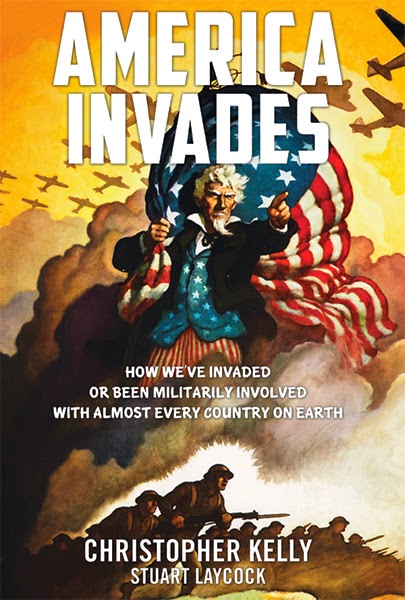
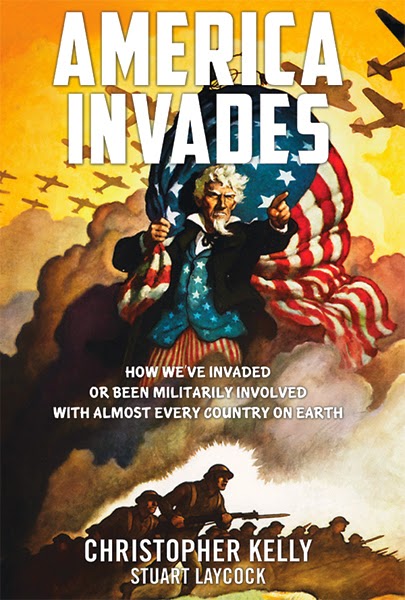
Stuart Laycock's All the Countries We've Ever Invaded and the Few we Never got Round to (The History Press, 2012,www.amzn.com/0752479695) is a clever little tour de force. Last summer the world "invaded" London to celebrate the Olympics, but Britain has invaded and intervened in countries around the globe for a very long time. In his opening paragraph Laycock informs us that 'we' (meaning Britain) have "invaded, had some control or fought conflicts in the territory of something like 171 out of 193 UN member states in the world today." The island nation of Britain has, therefore, invaded nearly 90% of all the countries in the world.
Nelson Monument, St. Paul's, London
This may not be too surprising given the fact that the British Empire once occupied about one quarter of the world's surface and included about one quarter of the global population. For many years, and particularly after Nelson's triumph at the battle of Trafalgar in 1805, the Royal Navy had unquestioned supremacy on the high seas. Britain ruled the waves and British warships often shelled enemy ports. When gunboat diplomacy failed, the Royal Marines could always be counted on to make a landing on a hostile shore.
Commander K. at Nelson's tomb, St. Paul's, London
Photo courtesy: Vincent Driano
Laycock has a fairly balanced view of British Imperialism. He writes, "It seems to me that some of the things we have done around the world are self-evidently wrong (like our deep involvement in the slave trade, which our later campaign against slavery in the nineteenth century only makes up for to a small extent), some are self-evidently right and there is a wide range in between. In some ways its a bit like your own life: there are some things you've done that you're ashamed of; there are things you've done that you're proud of; and there are things you've done that seemed like a good idea at the time, but don't now; and there are things you've done that seemed like a good idea at the time and still seem like a good idea. Whether wrong or right, all are interesting because they are our history, the history of a nation that dragged itself out of a small, cold wet island somewhere off the mainland of Europe to make a mark, for better or worse, on every corner of the globe."
Richard I, Houses of Parliament, London
Invaded Cyprus, Israel, Syria, etc.
In this slim volume Laycock focuses his attention on less well-known aspects of British history. It is well know that Cyprus was a British colonial outpost for many years (independent in 1960); it is less well know that Richard I ("the Lionhearted") led the first British invasion of Cyprus while on the Crusades in 1191.
Duke of Wellington Exhibit, Tower of London
Wellington led British forces in India, Portugal, Spain, France and Belgium
Laycock's book is divided into an alphabetical listing of contemporary countries and proceeds from Afghanistan (always messy) to Zimbabwe. The longest entry is appropriately France. Julius Caesar, perhaps in search of oysters and pearls, invaded Britain from Gaul in 55 and 54 BC (see earlier post, Oysters and Civilization, 2/4/13). William the Conqueror invaded England successfully from Normandy in 1066. The Duke of Wellington invaded France twice, in 1813 from Spain and in 1815 from Belgium after the battle of Waterloo. British troops were evacuated from Dunkirk in 1940 and landed in the invasion of Normandy on June 6, 1944.
Field Marshal Montgomery 1887 - 1976
Defended Egypt and led British invasions of Libya, Tunisia, Italy, France, Belgium,
The Netherlands, Germany and Denmark
St. Paul's, London
In his discussion of Britain's conflicts with the United States, Laycock includes one of my personal favorite wars -- the 'Pig war of 1859'. He writes, "Due to ambiguities in a treaty, the San Juan Islands lying between Vancouver Island and the North American mainland were disputed territory between Britain and the United States. In 1859, an American farmer on the island shot a pig he found in his garden. It turned out the pig belonged to a an employee of the Hudson's Bay Company and he wasn't happy (that is, the employee wasn't happy, though under the circumstances, I think we can conclude that the pig was none too happy about it all either). The conflict escalated, with US troops landing on the island, British warships arriving soon after, and a tense stand-off developing. Eventually, US and UK governments managed to calm things down, the matter went to arbitration and the islands were awarded to the US. In 1872, the Royal Marines stationed on the island finally departed." If only all wartime casualties were porcine!
My fellow Northwesterners can find traces of English influence all around them; Mount Rainier in Washington state was named after Rear Admiral Peter Rainier and the Puget Sound was named after lieutenant Peter Puget -- both names were chosen by Royal navy Captain George Vancouver.
I was fascinated to learn that Britain even intervened in Vietnam in the closing days of the Second World War. After the Japanese surrender, the local British Commander, Major General Gracey, even recruited Japanese units to help restore French control and suppress the Viet Minh. British involvement in Vietnam was mercifully short, ending in the summer of 1946.
Laycock neglects to mention Captain Cook's 'invasion' and death on the 'Sandwich Island' now know as the Big Island of Hawaii.
Commander Kelly says, "If you like quirky history told in a breezy unpretentious style, you will enjoy Layton's All the Countries We've Ever Invaded."
Special thanks to my brother-in-law Vincent Driano for giving me a copy of this book.
In 1942 How Green Was my Valley beat out Citizen Caine to win the Oscar for best picture.
In 1979 Woody Allen's Manhattan lost out to Kramer versus Kramer for best picture.
In 1994 Shawshank Redemption lost out to the annoying, sentimental Forest Gump for best picture.
Peter O'Toole has been nominated for best actor eight times and never won. Though he clearly deserved to have for won for his role as Lawrence of Arabia in 1962, the best actor nod went instead to Gregory Peck for his role in To Kill a Mockingbird (see earlier post, Lawrence of Arabia, 12/27/12).
At the 2013 Oscar awards the best picture made in 2012 was not even nominated for Best Picture. I enjoyed Argo (See earlier posts Argo, Art and the need for Camouflage, 12/3/12 Antonio Mendez' Argo and Iran today, 12/9/12) and and have great respect for Tony Mendez, but Argo was not the best picture of 2012.
Nor did the historically sloppy Lincoln (see my post Spielberg's Lincoln 2/6/13) deserve to take the best picture honors.
Commander Kelly declares the best picture of 2012...Skyfall (See earlier post Skyfall, 10/27/12). In fifty years, no Bond film has ever been been nominated for best picture. Adele did win this year for best original song and Skyfall also won a technical Oscar for best sound editing which doubled James Bond's Oscar total from 2 to 4 after fifty years of making Bond films (http://www.mi6-hq.com/sections/articles/event_oscars_2013.php3)! Skyfall was clearly punished for being excessively popular -- it was the first Bond film to generate over $1billion at the global box office. I would argue that while Argo represents a more balanced view of intelligence work than Skyfall (most intelligence workers are engaged in translation, technical work, satellite and cell phone monitoring, disguise and documentation like Tony Mendez and not "wet work" like Bond); nevertheless, Skyfall was by far the better film. Argo was a good film, a taut film, an interesting film, but it can't hold a candle to Skyfall!
Was Christopher Waltz, who won best supporting actor for his role in Django Unchained, really better than Javier Bardem in Skyfall who was not even nominated for best supporting actor?
In 1963, for example, From Russia With Love with Sean Connery was not nominated for Best Picture which was awarded to Tom Jones. Which is the more memorable and significant picture?
Did 2006's Casino Royale not deserve any consideration for best picture along with that year's winner, The Departed?
Could it be that Bond being punished by the Academy Awards for being to the right of most Hollywood productions (see earlier post Commander Bond's London, 2/23/12)?
Commander K. on the trail
Mount Obama (Boggy Peak), Antigua
What has roots as nobody sees,
Is taller than trees,
Up, up it goes,
And yet never grows?
Gollum's Riddlefrom The Hobbit, J.R.R. Tolkein
Last week Commander Kelly had an opportunity to climb the highest peak on the island on Antigua -- Mount Obama (http://antiguamountobama.com/)! Mount Obama was formerly known as 'Boggy Peak' and is the highest point on the Island / Nation of Antigua. The elevation is 1,314 feet or 402 meters, a mere pimple in the world of mountaineering.
Sugar Mill, Jumby Island, Antigua
The population of the island was 80,161 in 2011. About 91 percent of Antiguans are of African descent. Antigua formed part of the "Triangular Trade" of sugar, rum, slaves and manufactured goods that flowed between the West Indies, the American Colonies and Africa. Sugar was the main export of Antigua from the 17th century until sugar production closed down in the 1980's, due to cheaper Asian competition. For years the back-breaking labor of sugar cane production was furnished by slaves imported from Africa. You can still find old sugar mills all over Antigua today (see photo above).
Shortly after Nelson's decisive victory at Trafalgar in 1805, the Royal Navy had unquestioned dominance of the high seas -- Britain truly ruled the waves. In 1807 Britain abolished the slave trade and it was the power of the Royal Navy operating out of bases such as Antigua that was able to enforce this edict (see earlier posts, Horatio Nelson: Champion of Liberty 1/15/12, Nelson's Dockyard, Antigua 2/21/13).
Vorn on the trail
I hired an excellent local climbing guide, Vorn Johnstone. Vorn was quite unimpressed with the name change of the mountain to Mount Obama. I asked if there had been any increase in tourism since the name change which followed President Obama's election in 2009. He laughed and replied, "No".
It is impossible to get lost on the track to the summit. There is a badly paved road that leads all the way to the summit of Boggy Peak. A four by four could make the trip quite easily.
Purists will be disappointed to learn that the summit is on private property owned by Cable and Wireless. You will find communication towers, seismic monitoring equipment and a chain link fence at the summit of Mount Obama....
The top of Mount Obama
I am a slow climber and it took us about 2 1/2 hours to make the round trip journey to the summit and back. Global warming believers will be heartened to note that there was not a trace of snow on the summit of Mount Obama! Here is the view from the summit...
View from the Summit of Mount Obama
Antigua's primary industry is tourism. Very little is produced in Antigua. There is, for example, not even a local dairy on the island. Antigua does have some modest agriculture and we saw banana and mango crops growing on the route to the top.
Local kid with lamb
On the way down we ran into some adorable native children who generously brought us a basket of local fruit. The bananas and mangoes were delicious. The Antiguans are a kind-hearted welcoming people.
On the way up and down Mount Obama, dear reader, you may be astonished to know that I felt compelled to reflect on the more positive aspects of President Obama! Perhaps the easy ascent and tropical climate mellowed my curmudgeonly attitudes? I may have "conquered" Mount Obama, but perhaps the mountain affected me as well; mountains have a way of doing that.
Commander Kelly subscribes to the un-original notion that American Presidents have a dual job description, one Symbolic and the other Substantive. An American President must be a symbol of the nation's unity, celebrating our collective triumphs and mourning our losses. Our President also has a Substantive role as the leader of the Executive branch of government. This dual leadership role is explicitly clear in the UK where the Monarchy clearly handles the symbolism while the Prime Minister handles the substance of Executive decision-making.
Some US Presidents have been much better as symbolic leaders than substantive leaders and vice versa. President Nixon, for example was a disaster as a symbolic leader, though he had significant substantive achievements (opening China, ending the draft, clean air and water legislation, etc.). JFK, on the other hand, was a symbolic superstar, but had too little time to achieve much of substance during his tragically truncated term of office.
It must be conceded by even his harshest critics that President Obama has been a symbolically successful President for the United States. His election represented the closing of a long chapter of tortured race relations in North America. His elevation to the highest office represented a history-making development that inspired hope among millions throughout the world. A nation that was founded in large part by slave-owning plantation farmers from Virginia now has a black President.
Girl with lamb
President Obama is a good husband and father and these qualities should never be underestimated. He can certainly be an inspirational speaker. He is the twice-elected, legitimate President of the United States who was born in Hawaii. He is unquestionably a role model for millions of people of all races. He provided cathartic justice for a nation with the mission that targeted Osama Bin Laden. He also makes beer in the White House which is either awesome...or a crass bid for the alcoholic vote to contrast with the tee-totalling Romney (http://www.whitehouse.gov/blog/2012/09/01/ale-chief-white-house-beer-recipe)! I heartily acknowledge that he is an intelligent man of good will with whom I would be happy to drink a beer -- provided that he is paying!
Commander Kelly does not "hate" Obama by any means. I have great respect for him and even more for the office which he holds.
It is on mere issues of Substance that I sometimes disagree with our 44th President (lack of leadership on Syria, Sequestration debacle, Presidential kill list, drone foreign policy, gun control demagoguery, spiralling national debt, etc.). Commander Kelly must ask, "When the rhetoric of hope and change fade from the scene will Obama someday be re-named President Boggy Peak?"
After conquering Mount Obama, without use of oxygen, Commander Kelly naturally had to celebrate with a locally-made Antiguan product...Wadadli beer. "Ale to the chief!"
Wadadli Beer
Special Thanks to Vorn Johnstone who can be reached at vornjohnstone@hotmail.com to book your own Antigua peak experience. Thanks also to Altrec for the best climbing equipment (www.altrec.com). Keep Exploring!