A recent (9/15/14) article in the International New York Times was titled Obama reflects on past wars and campaign against ISIS. Peter Baker wrote about a foreign policy meeting held in the White House, "It was clear to the guests how aware Obama was of the critics who have charged him with demonstrating a lack of leadership. He brought up the criticism more than once with an edge of resentment in his voice. 'He's definitely feeling it,' said one guest. At one point Mr Obama noted acidly that President Ronald Reagan sent Marines to Lebanon only to have hundreds of them killed in a terrorist attack because of terrible planning, and then withdrew the remaining ones, leaving behind a civil war that lasted years. But Mr Reagan, he noted is hailed as a titan striding the earth."
This article raises a number of interesting points.
First, even the New York Times seems to have noticed Obama's lack of leadership!
Second, Obama is desperately sensitive now about his historical legacy. His vanity and ego are pricked at the thought of being compared unfavorably with past Presidents. He may fear that his primary historic legacy will be 1) a house and senate in Republican hands and 2) record gun sales.
Third, Obama's near total lack of historical perspective on the American experience is jarring.
I categorically assert that ALL American Presidents have been human beings and none has been perfect. Many Presidents have made many mistakes in their role as Commander in chief. That does not always make them losers.
George Washington
USMA, West Point, NY
George Washington, our first President, lost more battles than he won during the American Revolution. But it was his valor, persistence and astonishing integrity that is recalled today by Americans. His courage at Valley Forge and his leadership at Yorktown are his enduring legacy to our nation (http://americanconservativeinlondon.blogspot.co.uk/2014/02/fraunces-tavern-nyc.html).
Abraham Lincoln was a disastrous Commander in Chief during the early stages of the US Civil war. Lincoln the lawyer had virtually no military experience before becoming President. First Bull Run, the first major battle of the US Civil war, in 1861 was a farce for the Union. Lincoln appointed a series of dangerously incompetent Union general before eventually discovering talent such as Meade, Grant and Sherman. Yet Lincoln is justifiably remembered as one of the great winners of American history.
FDR
Grosvenor Square, London
Do we remember FDR as the leader on whose watch the Japanese struck at Pearl Harbor? Do we think of FDR as C in C for the battle of Kasserine pass in Tunisia where thousands of Americans were captured and many more fled at the approach of the Wehrmacht? No, we think of FDR as the victorious war time President who helped lead the Allies to victory in World War II.
Moreover, FDR was unafraid to articulate a clear strategy that the American public could understand and support: Unconditional Surrender. Could the American people have ever found a negotiated peace with Hitler politically or morally acceptable? Is FDR's clear cut approach not exactly what is needed in our current dealings with ISIS? Did FDR ever suggest that he wanted merely to degrade the Third Reich? No, he wanted to annihilate it.
Ronald Reagan
Grosvenor Square, London
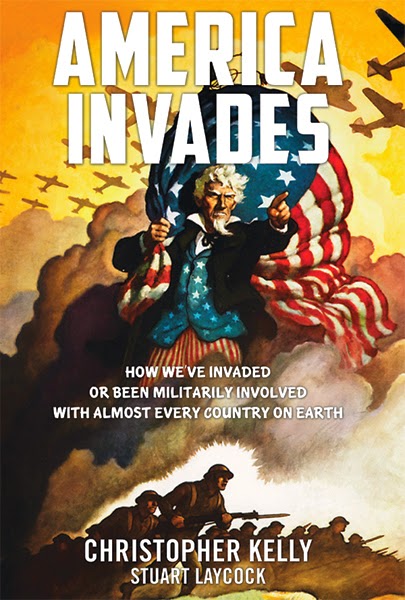
What about Obama's specific charge against Reagan? In my recent book with Stuart Laycock America Invades we write, "on October 23, 1983, a suicide truck-bomb loaded with TNT attacked the US Marine barracks, and 241 US and fifty- eight French servicemen were killed." (www.amzn.com/1940598427) Shortly after Reagan withdrew this peacekeeping force and a civil war did ensue in Lebanon. Our withdrawal from Lebanon may even have emboldened Saddam Hussein prior to his invasion of Kuwait. Reagan's Iran Contra arms for hostages deal was also a costly mistake which nearly derailed his second terms.
It would be absurd, however, to judge Reagan as a Commander in Chief solely on the basis of Lebanon or the Iran-Contra scandal.
Reagan's heart and faith informed him that the use of nuclear weapons by any nation was a sin. Many have been astonished to learn that he hated these weapons just as much as the long-haired anti-war crowd that had such contempt for him. Remember the "Ronnie Ray-gun" signs and Democratic conventions?
Reagan's great insight was simple but also masterful. Reagan, unlike any previous American President of the Cold War, was clever enough to realize that the Cold war was winnable. We remember him as a "titan" because he helped steer the West to victory in the cold War without firing a shot.
Stinger missile
USS Essex
Reagan helped to win the Cold War by strengthening the US military, by arming the mujahideen with stinger missiles that could shoot down Soviet helicopters in Afghanistan, by countering Soviet and
Cuban adventurism in the Caribbean and Central America and, finally, by calling for the execrable human rights scar of the Berlin Wall to be torn down.
Reagan, of course, did not win the Cold War single-handed. Many people (Thatcher, Pope John Paul, Lech Walesa, Truman, Eisenhower, George Kennan, etc.) in many countries deserve enormous credit for helping the Soviet Union to implode.
To judge the Reagan Presidency on the basis of the tragedy that took place in Lebanon in 1983 is simply to lack any real sense of historical perspective. Obama's partisan take on Reagan is just as shrill and unconvincing as the right wing loonies of the post war period who accused FDR of sinister betrayal at Pearl Harbor (http://americanconservativeinlondon.blogspot.co.uk/2012/12/fdr-in-london.html.)
Suetonius dishes the dirt on old Rome
Making the Case for Limited Government
Suetonius' Twelve Caesars (www.amzn.com/0140455167) belongs on the short list of books designed to bring active minds closer to the founding principles of Conservatism (along with Voltaire's Candide on the error of Utopian socialism...http://americanconservativeinlondon.blogspot.co.uk/2012/03/voltaire-conservative-of-enlightenment.html and Orwell's Animal Farm on the nature of political extremism...http://americanconservativeinlondon.blogspot.co.uk/2012/08/animal-farm.html). Suetonius wrote a gossipy, superstitious series of biographical sketches of the first twelve Roman Emperors that continues to fascinate to this day. Suetonius dishes the dirt on Rome's first twelve Emperors from Julius Caesar to Domitian. He informs us of the personal lives of the Emperors and the portents that seemed to predict their usually grisly deaths.
The 19th century English historian, Lord Acton, once wrote, "Power tends to corrupt, and absolute power corrupts absolutely. Great men are almost always bad men." Suetonius, living 1,900 years ago around the zenith of the Roman Empire, would surely have agreed. Suetonius was the private secretary to the Emperor Hadrian. His intimate portrayals of the Roman emperors demonstrate the corrupting influence of power. The Roman Emperors had absolute power over the lives of their subjects; they were also, with good reason, terrified of assassination. Their savage example provides the classic rationale for the necessity of limited central government.
They were also the chief inspiration for Mussolini's fascist state.
When master storytellers such as George Lucas and George R.R. Martin go looking for plot-lines it is to colorful histories like the Twelve Caesars that they turn. Star Wars' Galactic Federation devolves from Republic to Empire much like the Roman Republic. Game of Thrones has no more lust for power and erotic content than Suetonius' biographical sketches.
Julius Caesar
Mixed more than Salad
100 BC - 44 BC
Julius Caesar was the accomplished Roman general who crossed the Rubicon ("the dye is cast.") and became the founding father of Imperial Rome or the chief destroyer of the Roman Republic. Caesar was not just a winning general; he was an excellent writer who, like Churchill, chronicled his own accomplishments. He famously subdued Gaul -- "Veni, Vedi, Vici" -- and divided it into three parts. He led a raid of Britain perhaps for its oysters and pearls which were extraordinarily rare and valuable in the ancient world. His troops adored him.
Julius Caesar lived large. Suetonius tells us that, "his affairs with women are commonly described as numerous and extravagant." The most famous of these was surely with the Egyptian Queen Cleopatra who bore him a son.
On the Ides of march 44 BC it all ended very badly when he was stabbed twenty-three times by daggers in the Roman senate in one of the best documented conspiracies of all time (http://americanconservativeinlondon.blogspot.co.uk/2012/12/conspiracy-theories-old-and-new.html). The night before he had dined at Marcus Lepidus' house where he had publicly declared that "the best sort of death" would "come swiftly and unexpectedly". Finally, Caesar's ambition was realized.
Augustus
The Divine Augustus
63 BC - 14 AD
The month of August is named in honor of Augustus even though he was born Octavian. Augustus was adopted by Julius Caesar at the age of eighteen. After Caesar's assassination he joined with Mark Antony and avenged him. Suetonius informs us that very few of the dictator's assassins "outlived Caesar for more than three years."
Augustus would later fight and win a civil war with Antony and Cleopatra. But Augustus was not always a victorious Roman leader. In the wilds of the German forests three Roman legions led by Varus were massacred to a man in the Teutoburger Wald. Augustus was so shaken by these events that he beat his head against a door and shouted, "Quinctilius Varus, give me back my legions!"
Augustus was undoubtedly a tremendous builder. He famously said, "I found Rome a city of bricks and left it a city of marble."
It was during the month of August in 14 AD that the emperor died falling victim to an intestinal complaint. Some spread the rumor that his wife Livia may have helped him to the afterlife with poisoned figs.
Tiberius
"A wolf by the ears"
42 BC - 37 AD
Tiberius was Augustus' stepson, the oldest son of Livia. Tiberius distinguished himself as a Roman commander leading successful campaigns in Illyricum (roughly modern Croatia), Panonia (modern Hungary) and Germany. Suetonius fairly blushes to tell us that "some aspects of his criminal obscenity are almost too vile to discuss, much less believe. Imagine training little boys , whom he called his 'minnows', to chase him while he went swimming and get between his legs to lick and nibble them."
Tiberius was the Caesar that Jesus Christ himself told his followers "to render unto Caesar the things that are Caesar's and unto god the things that are God's." (Matthew 22:21) He was also Caesar at the time of the crucifixion.
Tiberius had a fondness for islands interrupting his meteoric career to exile himself to Rhodes in 6 BC. Later as Emperor he would retreat to beautiful isle of Capri of the coast of Sorrento. Reigning Rome from afar, he used the equestrian Sejanus to do his dirty work for him until he turned against him and wiped out Sejanus and his entire family.
Tiberius said that being emperor of Rome was like 'holding a wolf by the ears'.
Some sources suggest that his heir, Caligula, had Tiberius poisoned. Others assert that he was suffocated to death with his own bedclothes. We know for certain, however, that he his passing was little mourned. Suetonius writes that 'the first news of his death caused such joy at Rome that some people ran about yelling "To the Tiber with Tiberius!"
Gaius Caligula
Bad Boy or just Nickname Victim?
12 - 41 AD
The cruelty of Tiberius meant that the ascension of his nephew Gaius Caligula to the throne was greeted with general rapture; little did they suspect the horrors to come. Tiberius himself had prophesied that Gaius would prove to be a "viper in Rome's bosom".
Gaius had been raised in a Roman army camp where he had acquired the nickname "Caligula" or "little Soldiers boot" or "bootie-kins".
Caligula would become perhaps the most notoriously depraved Emperor in the long history of Rome. His brief life and bloody reign would become fodder for pornographers. He slept with boys, men, married women, all three of his sisters and even had time for his own wife, Caesonia, with whom he had a daughter.
He squandered the roman treasury with his extravagance. He would drink valuable pearls that had been dissolved in vinegar.
Gaius had nothing but contempt for the Roman senate. He even tried to award his horse, Incitatus, a consulship.
Finally, at the age of 29, he was assassinated along with his wife Caesonia and infant daughter by a conspiracy of Praetorian guards.
Claudius
"Mis-underestimated"
10 BC - 54 AD
After butchering Gaius Caligula, his assassins began to search the palace. Suetonius writes, "A common soldier who happened to be running past noticed a pair of feet beneath the curtain, pulled their owner out for identification, and recognized him. Claudius dropped on the floor and clasped the solder's knees, but found himself acclaimed emperor."
Claudius was the grandson of Augustus's wife Livia. He was assumed to be dull-witted on account of a series of diseases which struck him in childhood. He would, in fact become one of the most literate Roman emperors writing long historical works which, alas, have not survived.
He had notable successes such as the conquest of Britannia which even Julius Caesar had failed at. He went personally to Britain and earned a triumph.
The 'mis-underestimated' Claudius rates as one of the better Roman emperors who was proclaimed 'divine' after his death. Though he did mange "to execute thirty-five senators and 300 Roman equities" with little apparent concern.
Claudius was unhappy in love. His wife Messalina was notoriously unfaithful going so far as to enter into a bigamous 'marriage' with her lover Silius. After having her executed, a befuddled Claudius went in to dinner and asked, "Why is her ladyship not here?'
In his 64th year the emperor Claudius died. Suetonius relates that most Romans believed him to have been poisoned by a dish of mushrooms -- his favorite food.
Nero
"Angler in the lake of Darkness"
37 - 68 AD
It is a damned lie that "Nero fiddled while Rome burned"! He was actually 35 miles away in the town of Antium by the sea on the night Rome caught fire; besides, his preferred instrument was the lyre.
Shakespeare summed up Nero best in King Lear describing him as "an angler in the lake of darkness."
According to Suetonius, Nero raped the Vestal Virgin Rubria. He dressed in the skins of wild animals and "attacked the private parts of men and women who stood bound to stakes."
Suetonius informs us that he killed his second wife Poppaea by kicking her to death. She was pregnant and had complained about him coming "home late from the races". He was rumored to have had a hand in the death of Claudius. He did poison Britannicus who was a rival to the throne.
Suetonius blandly informs us that under Nero, "punishments were inflicted on Christians, a sect professing a new and mischievous superstition."
Nero embarrassed Romans with his extravagant philhellenism and grotesque vanity. He visited Greece and participated in Lyre competitions always managing to win the laurel. Nero really didn't want to be emperor; he wanted to be a contestant on Rome's Got Talent. Some of the crowd at these competitions feigned death in order to escape these excruciating performances. Nero was angler who didn't mind fishing for compliments in a stocked pond.
Inevitably Nero's excesses led to the formation of a conspiracy. Before being stabbed to death by one of his slaves, "he muttered through his tears, 'Dead! And so great an artist!'"
Galba
The chaos begins
3 BC - 69 AD
On Nero's death the aged Galba assumed the purple. He would only reign for seven months. His accession marked the beginning of 69 AD an orgy of civil violence known as the "year of the four emperors". Successive Roman generals of dubious pedigree would battle to win the Roman game of thrones.
Galba committed the unpardonable sin of slighting the Roman army. Suetonius tells us simply that "he outraged all classes at rome, but the most virulent hatred of him smouldered in the army."
He was murdered and decapitated by Roman soldiers beside the Curtian lake.
Otho
Died well
32 - 69 AD
Otho led the rebellion against Galba. On the night of his ascension he was said to have been haunted "by Galba's ghost in a terrible nightmare."
He reigned for three months which ended in his suicide.
Just before his death, he told his nephew, "Do not altogether forget, and do not too well remember, that you had a Caesar for an uncle."
Vitellius
"Sphincter Artist"
15 - 69 AD
Vitellius, his name says it all -- "emperor veal"! Could you imagine in America a President Porkchop or Senator Sausage?
Suetonius confirms his eternal status as a glutton. He writes, "Vitellius' ruling vices were gluttony and cruelty. He banqueted three and often four times a day, namely morning, noon, afternoon, and evening -- the last meal being mainly a drinking bout -- and survived the ordeal well enough by vomiting frequently."
Roman legions began repudiating him. Soldiers grabbed while a rabble began hurling insutls such as "Greedy guts" before he was tortured, killed and beheaded. His pathetic final words were, "And yet I was your emperor."
Vespasian
"Pitch me into the Tiber!"
9 - 79 AD
The ascension of Vespasian, acclaimed "divine" after this death, ended the brutal civil war that wracked Rome throughout the 'Annus horribilis' of 69 AD. He was the founder of the Flavian dynasty that brought a measure of stability back to an empire in turmoil.
In Matthew Dennison's Twelve Caesars (www.amzn.com/1250049121) he tells us that Vespasian "was a stranger to snobbery and too canny to allow himself to be rebranded in the Julio-Claudian mould. Even in his portraiture (see Aureus above) he eschewed their model, a bull-necked, bald-headed, warts and all imagery of age and its imperfections replacing the classicized perfection of those god-like Augustans."
Vespasian rolled up his sleeves and set to work rebuilding a shattered Rome. Suetonius writes that "he personally inaugurated the restoration of the burned Capitol by collecting the first basketful of rubble and carrying it away on his shoulders."
Vespasian delivered the funniest line attributed to ANY Roman emperor. On his deathbed Vespasian said, "I think that I am becoming a god."
Titus
Sacked Jerusalem
39 - 81 AD
Vespasian was succeeded by his son Titus who was an effective Roman military tribune in Germany, Britain and especially in Judea where he crushed a Jewish revolt, sacking Jerusalem.
Titus ruled with compassion providing assistance to the survivors of the eruption of Mount Vesuvius in Campania. He stripped his own mansions to provide relief for the victims of fire and plague.
Titus completed me in 80 AD!
Colosseum, Rome
Titus managed to complete construction of the Roman Colosseum that tourists gawk at today.
After a short but productive reign of just over two years Titus died of a fever at the age of forty-two.
Domitian
"Ah, to be as good-looking as Maecius thinks he is."
51 - 96 AD
Domitian, Titus younger brother, succeeded Titus to the throne. He was a frustrated young man who had lived under the shadow of his successful father and older brother.
He staged expensive entertainments such as sea battles in the Roman Amphitheatre but could never seem to purchase his people's affection.
Domitian's cruelty was heightened by cunning. He imposed heavy taxes upon the Jews. Suetonius tells us that, as a boy, he witnessed a ninety year old man stripped naked to determine whether he had been circumcised.
Again Suetonius dishes the dirt on Domitian writing that he "was extremely lustful, and called his sexual activities 'bed wrestling'".
It all ended very badly for Domitian who was stabbed in the groin and seven more times by the inevitable conspirators. Eventually, it would end badly for the Roman empire as well.
CONCLUSION
History may be nothing more or less than the record of man's crimes and follies, but Suetonius' lively and gossipy tales from two millennia ago prove that history can be entertaining.
Visitors to London this year will want to check out the Bond In Motion exhibit which is going on at the London Film Museum at least until the end of this year. Here is the link...http://londonfilmmuseum.com/home/. For those of us who remember the Bond film series with great affection this is a real treat.
Ian Fleming first portrayed Bond in a Bentley but the Aston Martin quickly became the quintessential Bond vehicle over many years. It has ejected passengers, sprayed machine gun fire, punctured tires, and even skied. It is well represented in this exhibition.
Glastron GT-150 and Crocodile Live and Let Die and Octopussy
Bond, as a Royal Navy Commander, is perfectly comfortable navigating the world's waterways in some extraordinary craft. Roger Moore piloted a speedboat through the Louisiana bayou in Live and Let Die. He also made his way to Octopussy's island off the Indian coast in a mechanical crocodile.
"Wet Nellie" Lotus Esprit S1 The Spy Who Loved Me
Once Bond even voyaged beneath the waves in a car that transformed itself into a submarine.
Auric Goldfinger's
Rolls Royce Phantom III
The diabolical villains that oppose Bond have had their own share of ostentatious vehicles, private planes and well-armed boats. Even with all this expensive technology they never seem to elude 007's special brand of justice.
My good friend Stuart Laycock wrote a book called All the Countries We've Invaded. I reviewed it earlier...http://americanconservativeinlondon.blogspot.co.uk/2013/03/all-countries-weve-ever-invaded.html. According to Laycock Britain has, over the course of its history, invaded or fought in nearly 90% of all the countries in the world. You can find Laycock's book here...www.amzn.com/B00GOHKY5O. The British Empire, on which the sun never set, once spanned about one quarter of the earth and one quarter of the world population.
If you want to gain an insight into the British forces that have done most of the invading please consider a visit to the National Army Museum in the Chelsea section of London. Here is the link for the National Army Museum...http://www.nam.ac.uk/. Sadly, the NAM is now closed for redevelopment until 2016. The museum is located near the Chelsea pensioners barracks which is the ancient home for retired British veterans. These are the fellows in those magnificent scarlet coats that one can still see tottering around London.
Commander K. with Napoleon's horse's skeleton
National Army Museum, London
At NAM you can trace the history of British land warfare from colonial days to the the present day. The Napoleonic era is well represented in this museum with displays of the battle of Waterloo, whose bicentennial will be celebrated next year (June 18, 2015).
Scotch Highlander
National Army Museum, London
Many generations of soldiers have taken the King's shilling and served their country around the world. English soldiers in the British Army were augmented by Welshmen, Scots, Irishmen as well as colonial troops including the extraordinary Gurkhas.
British Army Mustering Sergeant
National Army Museum, London
The class system that dominates so much of British society also obtained in the Army. The red coats worn by officers and sergeants were dyed with cochineal (made from beetles) while the coats of ordinary soldiers was dyed with madder, a vegetable dye, that tended to run in wet weather.
Many may recall the chorus from the television series Sharpe's Rifles written by John Tam (see video below)...
O'er the hills and o'er the main
Through Flanders, Portugal and Spain.
King George commands and we obey
Over the hills and far away.
British Colonial Redcoat
National Army Museum, London
The Pax Britannica was preserved in the 19th century with a "thin red line" of Colonial troops such as these. The phrase "thin red line" was originally coined by Times correspondent William Howard Russell who described a "thin red line, topped with a line of steel" at the battle of Balaklava in the Crimean war in 1854.
Commander K. and Protected Fighting Vehicle
National Army Museum, London
You can get a sense of life in the trenches in World War I and well as the Tommys' experience in WWII here. Even recent British deployments to Iraq and Afghanistan are featured here with many testimonies from serving soldiers.
I look forward to the re-opening of the NAM in 2016.
How many Americans have served their Uncle Sam "over the hills and far away"...?
I am excited to announce that this September a new history of America's Military Involvement with the world will be published. I have collaborated on this book with the historian Stuart Laycock. Our work is titled America Invades: How We've Invaded or been Militarily Involved with nearly Every Country on Earth. You can learn about our work here...www.americainvades.com.
The first American soldiers to visit the Northwest were Captain Meriwether Lewis and Captain William Clark on their 1804 expedition. They spent a wet winter on the Oregon coast near what is today the town of Astoria.
Commander K. with M4 Sherman
Fort Lewis Museum
In 1904 the US Army and Washington National Guard held maneuvers by the shores of American Lake in what is today Lakewood Washington (just south of Tacoma). In 1917, with America's entry into WWI fast approaching, the federal government bought the land on which Fort Lewis is located from Pierce county.
Fort Lewis Museum
Construction began on the camp on July 5, 1917 less than three months after the United States declared war on the Central powers in WWI. At an astonishing cost of just over $7 million 1,757 buildings and 422 other structures were erected in just 90 days. Many generations of soldiers would learn to become soldiers under the shadow of Mount Rainier.
Washington State's US Civil War History
The 91st Division, known as the "Wild West Division," trained at Fort Lewis prior to being sent "over there" to fight in Europe. The 91st was drawn mainly from soldiers from Western states. In spite of the segregation of the US Army at that time many ethnic groups did train at Fort Lewis. Squa De Lah, for example, was a native American who trained at Fort Lewis and was killed on Christmas day 1917 on the Western Front.
US Army Canon
Fort Lewis Museum
After WWI the site was allowed to languish becoming effectively a "ghost town". During the 1930s the pace of military activity picked up significantly at Fort Lewis.
Dwight D. Eisenhower
Grosvenor Square, London
From November 1940 to June 1941 Lt. Colonel Dwight Eisenhower served as chief of staff of the IX Army corps based at Fort Lewis. He was regarded as "amiable and efficient". Ike would, of course, become the leader of Operation Overlord -- the Allied invasion of Nazi-occupied Europe and, later, President.
Today the JBLM (Joint Base Lewis McChord) is home to over 25,000 military from the US Army and US Air Force. Visitors to the JBLM require a day pass which can be obtained with presentation of a valid driver's license, registration and proof of insurance at the visitor's center. See...http://www.lewis-mcchord.army.mil/des/le_visitor.htm).
This week I had the opportunity to tour the USS Essex while it visited Seattle for the annual Seafair celebration. The Essex is a USN Amphibious Assault ship (LHD-2) that was first launched in 1989. the ship can carry 33 aircraft, a crew of 1,200 as well as 1,800 marines. She is the fifth ship to bear the designation Essex and her nickname is "Iron Gator". Her motto is "Take notice" and her home base is San Diego.
USS Essex, Iron Gator
Seattle, WA
The first Essex was a 32-gun frigate that fought in the War of 1812. The fourth Essex (CV-9), launched in 1942, was an aircraft carrier with a distinguished record of service in World War II. Below you will see the original ship's bell from the WWII carrier...
Ship's Bell, USS Essex (CV-9)
The current USS Essex has a short flight deck which works for helicopters such as the new MV-22A Osprey and short take off aircraft such as the British-made Harrier jump jets. Some helicopters perform Search and rescue missions such as the one pictured below...
Search and Rescue Chopper
The Navy and Marine pilots aboard the USS Essex pride themselves on being "straight-shooters"...
USN Pilots are Straight Shooters!
The Marines aboard the ship even allowed the young gentleman pictured below to hold a stinger missile. President Reagan had these weapons shipped in quantity to the mujahideen during the Russian invasion of Afghanistan where they made a decisive difference in the conflict. This simple weapon is still in service.
Stinger missile
The USN defends our country and protects the free flow of commerce around the world. If you drive an imported car, thank the Navy. If you drink an imported beer, thank the Navy. If your job depends on exporting US-made products overseas, thank the US Navy.
The USS Essex has also been deployed on numerous humanitarian missions. Thank you for your service to all those who serve aboard the USS Essex!