Monday, January 18, 2016

The OPAD Loop: The American Way of War

The author at the grave of his ancestor
Stephen Van Rensselaer
Albany Rural Cemetery, NY
INTRODUCTION: THE OPAD LOOP

Is there American way of War?  Is there a discernible historical pattern to the way in which we as a people engage in war?

Colonel John Boyd, an ace fighter pilot and trainer, conceived the OODA loop to explain the mechanics of aerial combat.  OODA stands for Observe, Orient, Decide and Act.  Each Action leads to a new Observation (the target is hit or missed) and the loop continues.  Boyd's insight into conflict resolution is applicable to ANY competitive landscape had been utilized in fields from sports to business as well as warfare.  The military understands that speed is of the essence when flying in the OODA loop.  The warrior's very survival depends on his constantly asking himself, "Where am I now in the OODA loop?" and "Can I accelerate versus my opponent?"

The OODA Loop has even put used to improve one's golf swing (http://www.creategolfers.com/2013/08/ooda-your-way-to-better-golf.html)!

Boyd's revolutionary approach provided a new way to describe the tactics of armed conflict.  (See earlier post...http://americanconservativeinlondon.blogspot.co.uk/2012/01/colonel-john-boyd.html)

I detect an OPAD Loop through history which may be used to describe the strategic cycles that define the American Way of War.  OPAD loop is strategic rather than tactical and helps to describe the stages of our nation's military history.

"O" stands for "Overconfident and Ill-prepared".  An excess of confidence and a lack of proper preparation characterize the period that precedes the commencement of hostilities and lasts through each war's initial battles.

"P" stands for "Painful Lessons".  We seem only to learn from hard experience.

"A" stands for "Adjustments".  Course corrections are implemented as a direct result of the "Painful Lessons".

"D" stands for "Decisive Victory".  At long last, a decisive victory is won.  But as we celebrate the triumph we often forget that it is precisely this victory that puffs the bellows of national pride leading to Overconfidence and poor preparation for the conflict that waits around the next corner.


"O" -- OVERCONFIDENT AND ILL-PREPARED

All too often the lead-up period to war and its earliest stages are characterized by American overconfidence and poor preparation.

The War of 1812 affords an early example of "Overconfident and Ill-prepared".
General Stephen Van Rensselaer
Albany Rural Cemetery, NY
In August of 1812 former President Thomas Jefferson wrote that, "The acquisition of Canada this year, as far as the neighborhood of Quebec, will be a mere matter of marching."  President Madison, a Jefferson acolyte, had launched a war against Britain in June of 1812 in spite of the fact that the US Army had less than 8,000 regular troops, was unprepared for winter warfare in the vastness of Canada.  There were more troops in the state militias but many of these were prevented from leaving their home state and could not possibly invade British Canada.  My own ancestor, General Stephen Van Rensselaer led the New York militia many of whom balked at the rive border between upstate new York and Canada.  The US Navy, for its part, had no ships of the line while the British had over five hundred.  Instead the Navy relied upon gunboats (Jefferson liked the fact that they were cheap) that were incapable of challenging the Royal Navy's Blue water fleet.
Picnic at First Bull Run (Manassas)
There are many more examples of American Overconfidence and poor preparation.  On July 21, 1861 at First Bull Run, the first major battle of the US Civil War, "a throng of sightseers," politicians and some women rode carriages equipped with picnic baskets 25 miles from Washington to observe the Union Army teach a lesson to "Johnny Reb".  Instead they witnessed the bloodiest day in US history up to that point in time as the Confederates "whupped" the Yankees who skedaddled from the field.


Yankee Doodle Dandy, James Cagney

In April 1917 George M. Cohan wrote Over There about how "the Yanks were Coming, etc." as Wilson plunged us into war against the "Hun".   The American military, in spite of having witnessed the agony of trench warfare from August 1914 until that point, was woefully unprepared for war.  More than 100,000 Americans would be killed Over There in World War I over the course of about 20 months -- nearly twice as many as killed over the ten years of America's experience in Vietnam.

Eddie Rickenbacker's Spad XIII (replica)
Imperial War Museum Duxford, UK
By 1917 the importance of aviation in modern warfare was clear to all.  Aviation may have been invented by the Wright Brothers of Ohio and Kitty Hawk but America had no military aviation industry throughout the war.  American air forces purchased Sopwith Camels from Britain, Spads from France and Capronis from Italy.  Eddie Rickenbacker, the leading American ace of the war, flew a Spad XIII.
Frank Knox
Secretary of the Navy WW2
The hubris that preceded the Japanese attack on Pearl Harbor was legendary.  Before the "day of infamy" Frank Knox, the US Navy Secretary wrote, "We can wipe the Japanese off the map in three months."   Knox assured Governor Spaulding of New Hampshire that "the Japanese cannot fight longer than two months".  (Source: Freedom Betrayed: Herbert Hoover's Secret History of the Second World War., p 295, Edited by George  Nash, 2011, www.amzn.com/0817912347).

But it seems that the lessons of World War II would be quickly forgotten.
Start of Korean War
By the end of WW2 in 1945 the Americans had built up a formidable military force.  But by June 1950, when the North Koreans invaded the South, demobilization ordered by the US Government had eviscerated the US military. English historian Max Hastings wrote, "In the aftermath of World War II, the nation's armed forces had not merely been reduced -- they had been allowed to crumble to the brink of collapse...By June 1950 MacArthur's division in Korea lacked 62 percent of their infantry firepower and 14 percent of their tanks; that 80 percent of the army's sixty day reserve was unusable and the army in Japan possessed only forty-five days' supply of ammunition."  (Source: The Korean War, Max Hastings, 1987, p 52, www.amzn.com/067166834X).  These ill-equipped forces were very nearly routed by the Communists at the start of the war which only turned around with MacArthur's landings at Inchon.

I use the term "ill-prepared" rather than "unprepared" advisedly.  Americans are often prepared to fight a war but they are prepared to fight the last war rather than the next war.  Victory over Saddam in the First Gulf War, for example, did not prepare us to deal with the insurgencies of subsequent wars in Iraq and Afghanistan that followed 9/11/


P -- PAINFUL LESSONS
George Washington
USMA, West Point, NY
On August 27, 1776 America's first Painful Lesson was administered by the British at the Battle of Long Island (also Battle of Brooklyn)  (en.wikipedia.org/wiki/Battle_of_Long_Island).  After suffering about 2,000 Continental casualties, George Washington was forced to withdraw Patriot forces from Long Island to Manhattan.  The next month would see Washington abandon New York City which would remain occupied by British forces until the end of the war in 1783.  New York City would become a Tory stronghold for the remainder of the war.

Many Painful Lessons would follow in the American Revolutionary War and in all subsequent conflicts.

The Mexican-American War (1846 - 1847) and Spanish-American War (1898) were both relatively short wars that produced significant American territorial gains.  After the Mexican-American war territory forming California, Nevada, Utah, Arizona and New Mexico were added to the Union.  After the Spanish American War Puerto Rico and Guantanamo were added to American control.  But both wars had Painful Lessons of their own.  Both wars claimed many American casualties due to disease with the wars being fought in tropical climates.  During the Mexican-American War a higher percentage of those serving died than in any other American war.  The occupation of the Philippines that followed Dewey's naval victory at the Battle of Manila Bay degenerated into a long and brutal guerrilla war.

The US Civil War, the costliest in our nation's history, was full of Painful Lessons.  The Battle of Antietem on September 17, 1862, for example, killed more on one day than any before or since in American history.
Carnage on the Atlantic Coast
The American experience in World War II would begin with the Painful Lesson of Pearl Harbor (http://americanconservativeinlondon.blogspot.co.uk/2015/12/lesson-of-december-7-1941.html).  Immediately following the Japanese attack, German U-boats were dispatched to the coastal waters of the eastern seaboard in Operation Drumbeat where they preyed on merchant shipping that was illuminated by the undimmed city lights  (http://americanconservativeinlondon.blogspot.co.uk/2016/01/operation-drumbeat.html).  Over the first eight months of 1942 more 5,000 merchant mariners would be killed (twice the toll of Pearl Harbor) partly due to the US Navy's refusal to implement convoys in these waters.  Kasserine pass in Tunisia would hold more Painful Lessons for the US Army.

Nor are Painful Lessons limited merely to the opening rounds of American wars.  The Battle of the Bulge which began in December 1944 was the costliest American Battle of World War II (http://americanconservativeinlondon.blogspot.co.uk/2012/10/battle-of-bulge.html).  At Bulge Americans learned that even a dying beast can maul its hunter.

A -- ADJUSTMENTS

The record shows that Americans at war, after suffering Painful Lessons, make significant adjustments in terms of strategy, tactics, leadership, technology and even military medicine.
Baron Von Steuben
Valley Forge, PA
After the Battle of Long Island George Washington engaged the services of the Prussian "Baron" von Steuben who taught Americans how to drill and fight as regular troops at the encampment at Valley Forge and thereafter.  In America Invades we wrote, "von Steuben from Magdeburg Prussia became a major general in the Continental Army and wrote the drill book (Revolutionary War Drill Manual) that was used by the US Army until the War of 1812." (Source: America Invades, Kelly/Laycock, 2014, www.amzn.com/1940598427)  Washington recognized that Americans could not defeat the British by shooting soldiers from behind trees Indian style; they could only defeat British regulars by learning to fight in formation like European armies.

During the US Civil War President Lincoln made numerous leadership changes before settling on the team of Meade, Grant and Sherman to win the conflict for the Union.  Truman felt compelled to dismiss MacArthur during the Korean war.   George W. Bush eventually accepted Donald Rumsfeld's resignation.  And so on.

The US Naval cryptanalysts that failed us before Pearl Harbor would succeed marvelously at the Battle of Midway.  Convoys would finally be instituted after the carnage of Operation Drumbeat.

A little known campaign in the Aleutian islands in 1942 illustrates the adjustments that were made in military medicine at that time.  Historian Brian Garfield wrote, "The largest single classification of agony--severe frostbite and trenchfoot--represented the first combat cold injuries suffered by American troops in the Second World War.  To avoid making the same grisly mistakes in the forthcoming Italian campaign, Army doctors studied Attu veterans with close clinical attention, and submitted voluminous findings to the Surgeon General.  As a result, important changes were soon made in Army footgear, clothes, tents bedrolls and food.  In the next two years' global fighting, the experience of Attu would save thousands of limbs and lives."  (Source: The Thousand Mile War, Brian Garfield, 1969, p 333, www.amzn.com/0912006838).

The Manhattan project that developed the atomic bomb provides a perfect example of a technological adjustment to the strategic needs of the Second World War.  The nature of warfare changed as a result.

D -- DECISIVE VICTORY

The American Way of War ends in Decisive Victory.  The Battle of Yorktown ratified in  blood the aspirations of the Declaration of Independence.  In 1847 General Winfield Scott led US forces into Mexico City.  Sherman ignited Atlanta to finish off the Confederacy.  The Spanish Empire crumbled at San Juan Hill and Manila Bay.  The Kaiser was forced to abdicate his throne.  Berlin and Tokyo were left a heap of smoldering ruins by the end of WW2.  Saddam's Republican Guard attempted ruinously to flee Kuwait with stolen vehicles on the "highway of death".
George S. Patton
USMA West Point, NY
Patton, the American Mars, confidently opined, "America loves a winner, and will not tolerate a loser, this is why America has never, and will never, lose a war."

Most historians agree that the War of 1812 basically ended in a draw with no territory changing hands.  But even this inconclusive war ended with Decisive American victories on water (Battle of Plattsburgh, 1814) and on land (Battle of New Orleans, 1815).

VIETNAM AND THE OPAD LOOP

Patton, of course, spoke prior to the Vietnam war. While it must be acknowledged that Vietnam was a defeat for the USA, OPAD still provides a framework for trying to understand this American war.

Americans had plenty of Overconfidence at the start of the Vietnam War.  JFK intoned, "We will bear any burden" but his listeners had no idea that the full reckoning would cost over 50,000 American lives.  From the Gulf of Tonkin incident to the escape of the Boat people, Vietnam furnished Americans with many "Painful Lessons".   General Westmoreland's  sacking by LBJ after the Tet offensive was one of many Vietnam adjustment.  But Decisive Victory proved to be elusive in Vietnam.

Or did it...?  American forces did not really lose a single pitched battle in the course of the Vietnam War.  The Tet offensive in 1968, for example, was a propaganda and media victory for the Communists but in purely military terms they were routed everywhere by its conclusion.

POW John McCain returns to USA
Finally, from the perspective of the global Cold War that was waged from 1946 to 1989, Vietnam was itself simply a Painful Lesson that Americans incorporated into a ultimately winning strategy.  Senator John McCain, a Vietnam POW, mused, "Perhaps we couldn't have won the Cold War if we hadn't lost the Vietnam War."  (Source: Vietnam: The Definitive Oral History Told From All Sides,  edited by Christian G Appy, 2003, p 482, www.amzn.com/0091910129).  Without question Vietnam's Painful Lessons led to a wholesale reform of the US military.  The draft was replaced by a volunteer military.  The media would be granted limited access to future battlefields.  Colin Powell, a decorated Vietnam veteran, would champion many of the reforms that swept the US military after the fall of Saigon.


WHY THE LOOP?

Why do we Americans tend to careen from Decisive Victory in one war to Overconfidence and IIl-preparedness at the start of the next conflict?

Decisive Victory has a causal relationship to Overconfidence.  Part of this is simply due to human psychology.  Triumph puffs up the bellows of the national ego leading to excessive complacency.  Meanwhile, American triumphalism helps to foster resentment among those around the world who wish us ill.
"Wild" Bill Donovan of the OSS
Truman's decision to eliminate the OSS (Office of Strategic Services) in September 1945, just one month after the atomic bombs were dropped, offers a precise historical example of how this operates in practice.  Truman was a frugal man from Missouri and the OSS was run by a "Wild" Bill Donovan -- a notorious playboy and...Republican.  Truman concluded that the war had been won and there would be no more need for intelligence services.  Truman would readjust his adjustment when the CIA was reconstituted out of the ashes of the OSS in 1947 to address the challenges of the Cold War.
9/11 Memorial, Lower Manhattan, NY
Moreover, Decisive Victory is, by definition a very public event.  Every Decisive Victory that is won effectively hands the American playbook over to any future enemies that may arise.  Osama Bin Laden, for example, knew well to avoid Saddam's experience from the First Gulf War that was won in just 100 hours of ground fighting in 1991.  He would be the architect of an altogether different attack on America.


THE OPAD LOOP TODAY?

Where are we today on the OPAD loop of American military history? President Obama was quick to dismiss ISIS as the "JV team" demonstrating the American penchant for Overconfidence once again.  Will we now accelerate towards Decisive Victory against ISIS or must we endure more Painful Lessons and Adjustments?

Everyone has an opinion but only future historians will be able to provide the complete answers.

Thanks Washington Times...http://www.washingtontimes.com/news/2016/feb/9/christopher-kelly-historical-loops-of-presidents-a/

Thanks Courier Post...http://www.courierpostonline.com/story/opinion/columnists/2016/02/14/commentary-can-deliver-decisive-victory/80301276/

Thanks Daily Journal...http://www.thedailyjournal.com/story/opinion/columnists/2016/02/14/commentary-can-deliver-decisive-victory/80301276/

Thanks South Coast Today...http://www.southcoasttoday.com/article/20160215/OPINION/160219788/0/SEARCH

Thanks Tampa Tribune...http://www.tbo.com/list/news-opinion-commentary/christopher-kelly-us-presidents-and-the-american-way-of-war-20160215/

Thanks Times Tribune...http://thetimes-tribune.com/opinion/winning-wisely-by-respecting-opad-loop-1.2007212


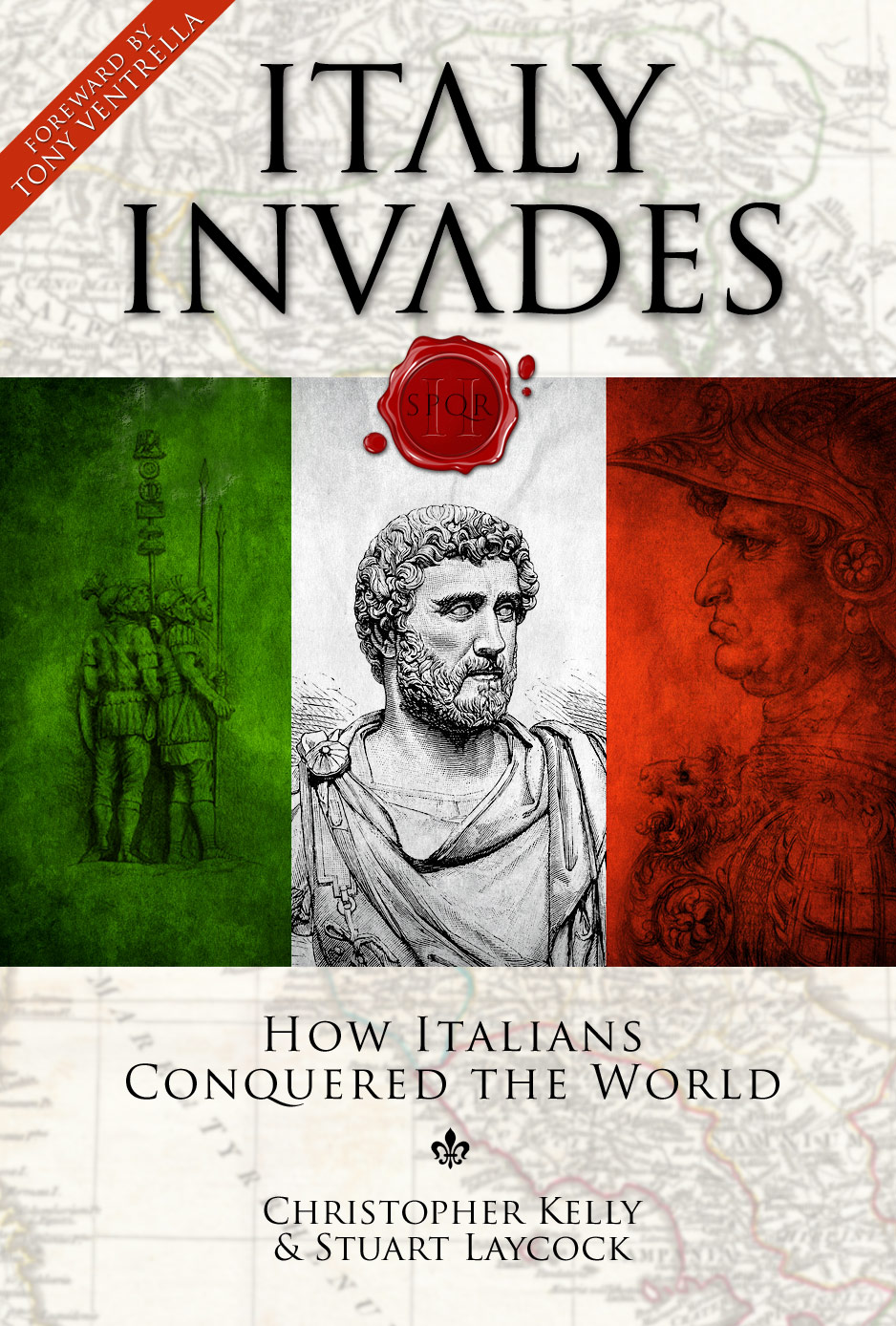
Christopher Kelly is the Co-Author, with Stuart Laycock of America Invades and Italy Invades: How Italians Conquered the World.   

You may find signed copies here...www.americainvades.com
  
And unsigned copies are available here 
on Amazon...


Thursday, January 14, 2016

Operation Drumbeat


Operation Drumbeat (www.amzn.com/1591143020) is an extraordinary book about Nazi submarine warfare in World War II.  Published in 1990, it was written by Michael Gannon – a Catholic priest from Florida.

Operation Drumbeat (“Paukenschlag”) was launched by the Kriegesmarine immediately following the Japanese attack on Pearl Harbor on December 7, 1941.  German U-boats were sent from bases in France to attack merchant ships in the coastal waters of the United States.  In the eight months following Pearl Harbor almost 400 ships were sunk of the US Atlantic coast killing more than 5,000 merchant mariners – more than twice as many as were killed on December 7 in Hawaii.

The astonishing and shocking message of this book is the ineptitude and complacency of the US Navy at the start of the conflict.  The utility of convoying merchant ships had been proven in WWI and by the British experience in the opening years of WW2.  But we Americans seem to have forgotten these painful lessons.  Gannon blames Admiral J. King for the US navy’s inadequate and slow response to the U-boat menace.  Even the mild-mannered General Eisenhower wrote, “One thing that might help win this war is to get someone to shoot King.”

The coastal waters of the Atlantic were left almost undefended for the Nazi U-boats to prey on.   Gannon has closely researched the career of Captain Reinhard Hardegen who skippered U-boat 123 (“Eins, zwei, drei”) in Operation Drumbeat.  On January 13, 1942 a coordinated assault conceived by Admiral Donitz on merchant shipping in American coastal waters began.  Hardegen sunk freighters that were illuminated by the incandescent city lights of New York City – no black out or dim out orders had been given.  Later Hardegen would sink merchant shipping off the coast of Florida during what the Germans referred to as the "Happy Time".

Eventually, the US Navy did improve its performance with the implementation of active convoying and improved air patrols.

By all accounts Hardegen was beloved by his crew, most of whom, against the odds, survived the war.   Unlike many Japanese subs in WW2, Hardegen did NOT order the deliberate massacre of sinking vessels’ crew members.  On the contrary he even stopped in the mid Atlantic to request that a neutral Swiss vessel come to the aid the survivors of the Pan Norway that he had sunk earlier.

Gannon writes an astonishing empathy for Hargen and his crew while noting that the Kriegesmarine was “an armed force in service to objective evil”.  He suggests that “most German officers and ratings went to sea for Navy, not for Nazi, reasons.”
German U-boat, WW2
Gannon destroys many of the prevailing Hollywood myths about submarine warfare in WW2.  U-123, for example spent the vast majority of its multiple transatlantic cruises on the surface and NOT submerged.  On the surface it was nearly three times faster than below.  Nor were all submarine attacks delivered by torpedos.  Hardegen often used his ship’s 10.5 cm deck guns to sink merchant ships.

In many ways the Battle of the Atlantic was the decisive war-winning Battle fought by the Western Allies in WW2.  Without it tons of Lend Lease materials could never have been delivered to the Soviets, the British and other Allies.  Without it the American and Canadian troops that stormed the beaches on June 6, 1944 could never have made it to their staging area in Britain.

This is an important and well-told tale about a vitally important part of WW2.
Captain Reinhard Hardegen, U-123
Reinhard Hardgen, mistaken for an SS officer spent time in jail after the war.  He founded a successful oil company in 1952.  Astonishingly, the former skipper (born 1913) is alive at age 102 and still plays an occasional round of golf!

Christopher Kelly is the co-author, with Stuart Laycock, of America Invades and Italy Invades: How Italians Conquered the World.


His books can be found here...www.americainvades.com
and here...


Tuesday, January 5, 2016

Something Fresh

1915 - 2015
Still Fresh!

In late September of 1915 the British Army launched the Battle of Loos on the Western Front.  This marked the first use of poison gas by British forces in the Great War.  The Tommies would suffer nearly 60,000 casualties in this appalling battle.

That same month, just over a hundred years ago, a novel called Something Fresh by PG Wodehouse was published (www.amzn.com/1585676586).  Something Fresh was the first in a series of novels that would be set in and near Blandings Castle -- Jeeves and Wooster would follow.  Some of those poor Tommies in the trenches could, therefore, have had a copy of the Wodehouse classic.  Fiction provides us with a means of escape and the soldiers on the Western front were sorely in need of that.
Blandings Castle...?
In spite of the wartime horrors that loomed so large at its writing and publication Something Fresh does not give even a hint of being a "wartime" book.  Instead it is a brilliantly written comedy masterpiece.  Its hero and heroine are two young hack writers living in London's Leicester square.  Ashe Marson is the athletic creator of The Adventures of Gridley Quayle Investigator with installments such as The Adventure of the Wand of Death.  Joan Valentine writes short stories about the nobility for a "horrid little paper" called Home Gossip.  She is described as being "a tall girl, with wheat gold hair and eyes as brightly blue as a November sky when the sun is shining on a frosty world."  Comely Joan is, of course, the love interest.

The really astounding thing about Something Fresh is that, a hundred years later...it still is.

Roast Beef of Old England
Simpson's in the Strand, London
Two Wodehouse characters dine out in London.  "Simpson's in the Strand is unique.  Here, if he wishes, the Briton may, for the small sum of half a dollar, stupefy himself with food...A pleasant, soothing, hearty place.  A restful Temple of Food."  Having dined there myself, I can testify that, with the exception of the prices, Simpsons remains just as Wodehouse described it (http://www.simpsonsinthestrand.co.uk/).  When the silver trollies roll by your table be sure to slip your waiter a fiver for a larger slice of roast beef!
Egyptian Cheops Scarab of the Fourth Dynasty!
An American millionaire, J. Preston Peters, has his prize Scarab pilfered by the scatter-brained Lord Emsworth, Blandings' owner.  Our impecunious hero and heroine are engaged to recover it.  Will Lord Emsworth's idiot son, Freddie Threepwood, marry Peter's daughter Aline?  Or will another win her heart?  Will love triumph in the end?

The cigar-chomping Peters suffers almost as much from indigestion as from his lost Scarab.  He agonizes over the contents of his stomach lining like a 21st century hypochondriac popping his Probiotic pills.  Something Fresh remains timely.

If you are an anglophile seeking escape from depressing American Election year news or an insipid sixth season of Downton Abbey pick up a copy of Something Fresh.  One hundred years later it still has the power to make us laugh and lift our spirits.

Christopher Kelly is the author of America Invades and Italy Invades: How Italians Conquered the World.


Wednesday, December 30, 2015

The Wright Brothers


David McCullough is an American national treasure.  His latest book, The Wright Brothers (www.amzn.com/1476728747), is an instant classic.

McCullough tells the story of the Wright Brothers’ lives in the American Midwest with great clarity and grace.  Wilbur and Orville grew up with their sister Katherine in Dayton, Ohio.  Katherine is given a justifiably prominent place in this story.  Their father, Milton Wright, was a Bishop in the United Brethren church.  Bishop Wright described his sons as being “Independently” Republican.

Wilbur and Orville Wright were brothers who complimented each other.  Both shares a phenomenal work ethic that drove them on to extraordinary achievement.  Both demonstrated enormous physical courage in the early testing days at Kitty Hawk and Dayton.

At the dawn of the 20th century human flight was a dream shared by some hopeful inventors and a few cranks.  Many governments, including the USA, spent a fortune to make it a reality.  But it was this amazing labor by two American brothers who were bicycle mechanics that transformed a dream into the reality of controlled manned flight.

Wilbur and Orville succeed not merely in their invention of powered flight but also in the promotion of their invention.  The demonstrate their fragile contraptions in France before spectators such as King Edward VII and many more.  They become successful men of business.

McCullough points out that Wilbur lived long enough to see the destruction caused by military aviation in World War II.  Wilbur saw himself explicitly and accurately in Promethean terms.  He wrote…"We dared to hope we had invented something that would bring lasting peace to the earth.  But we were wrong.  No, I don’t have any regrets about my part in the invention of the airplane, though no one could deplore more than I do the destruction it has caused.  I feel about the airplane much the same as I do about fire.  That is I regret all the terrible damage done by fire, but I think it is good for the human race that someone discovered how to start fires and that we have learned how to put fire to thousands of important uses.”

This is an important story told by a master storyteller.  This is an old fashioned book about men with old fashioned values who did more than any two people to create our modern world.

Black and white photography enhances the book.

My only quibble with McCullough’s book is that, at 320 pages, it is just too short!


You can find Commander Kelly's books America Invades and Italy Invades on these web sites...


Thursday, December 24, 2015

Rome brought Christianity and Rabbits to Britain

Stuart Laycock, me and Trajan
 Tower Hill, London
Merry Christmas 2015!

In the United Kingdom chapter of our new book, Italy Invades: How Italians Conquered the World, we noted the profound impact that Rome had on Britain.  They may have come for the pearls but their legacy was Christianity, literacy, rabbits and much more...
Julius Caesar
Archaeological Museum, Arles, France
The Romans had long been aware of the presence of Britain, but they finally arrived in force in 55 BC. According to Suetonius, they came in search of pearls that were much prized by the women of Rome. Colchester became a significant town in Roman Britain, and remains a center of oyster production to this day. Julius Caesar, on the lookout for new victories after rampaging across Gaul, took Roman troops onto British soil for the first time. It wasn’t a great success for Caesar, as storms in the English Channel threw his plans into disarray. He withdrew to Gaul fairly rapidly.
He returned in 54 BC and made a rather more determined invasion of the island. This time, he managed to penetrate some distance inland and achieve a kind of victory over local British leader Cassivellaunus. However, in the end, once again, the Romans withdrew.
Emperor Claudius
Uffizi Gallery, Florence, IT
It was not until almost a century later, in AD 43, that the Romans, during the reign of Emperor Claudius, invaded Britain and managed to impose long-term occupation on most of what is now the United Kingdom.

The British tribes were not united in opposition to Rome. Roman forces advanced in the east and fairly soon took Colchester, and then expanded control across other parts of Britain. The future emperor Vespasian campaigned in the southwest; and soon Roman forces entered what is now Wales, where they encountered fierce fighting.

And all was not well for Rome in the east of the island. In AD 60 or 61, the mighty Iceni tribe under their queen Boudicca rose in revolt. The rebels enjoyed some success against Roman forces before eventually being crushed, with much attendant slaughter.


Emperor Hadrian
Uffizi Gallery, Florence, IT
Eventually, the Roman invaders focused on the drive north, which would take them into what is now Scotland. However, despite repeated pushes into the area, Rome would never firmly control much of what that territory. Agricola, for instance, thrust north before Hadrian built his seventy-three-mile wall to establish the long-term frontier. Hadrian’s Wall, now a UNESCO World Heritage Site, was mainly constructed by three Roman legions (about 15,000 men) with around two million tons of stone over at least six years. Hadrian’s Wall is a tangible reminder of the impact of Italian invasions on Britain; it may also have provided inspiration for George R. R. Martin’s dividing wall in A Game of Thrones.


Hadrian's Wall
Ran for 73 miles across Northern Britain

Under Antoninus Pius, the Antonine Wall was built farther north, temporarily sealing a large chunk of what is now Scotland within the empire, but then that was abandoned. In another example, Septimius Severus campaigned in the north, but again, his temporary conquests achieved little. Constantius and his son Constantine both campaigned in the north.


No Italian Invasion = No Watership Down
Christianity became widespread in Roman Britain especially after the conversion of Constantine, who was acclaimed emperor in York in 306. The Romans also introduced rabbits to Britain. No Roman invasion, therefore, would have meant no Watership Down.

However, as Roman power in Britain weakened in the late fourth and early fifth centuries AD, peoples from north of Hadrian’s Wall and peoples from across the North Sea began raiding inside Roman-controlled Britain. Eventually, Roman power in Britain ended entirely as much of the army left for Gaul to pursue Constantine III’s ambitions there. Britons probably started fighting other Britons then, as Britain fragmented."  Source: Italy Invades: How Italians Conquered the World, Kelly / Laycock, 2015.

For more on the collapse of Roman Britain that followed the fall of Rome see our earlier post Was King Arthur Italian? (http://americanconservativeinlondon.blogspot.com/2015/11/was-king-arthur-italian.html)

To get your signed copy of Italy Invades: How Italians Conquered the World...
Or on Amazon here...
The full Italy Invades Package is available 
only here...

Thursday, December 17, 2015

Star Wars: The Force Awakens

December 16, 2015, London Odeon

Last night my son and I had the distinct honor to attend the European premiere of Star Wars: The Force Awakens in London.  Most of the cast were there along with George Lucas and the film's director J. J. Abrams.  Robert Iger, Disney's Chairman was there to kick things off.  Disney's stock price has ticked up as the positive reviews are rolling in.

Inspiration for Lucas
Here is the history of Star Wars in one paragraph.  The Swiss psychologist Carl Jung ripped off world mythology.  Joseph Campbell ripped off Jung.  George Lucas ripped off Campbell to make the original Star Wars.  And now Disney and J. J. Abrams are ripping off Lucas to make The Force Awakens.  In 2015 we have the Hero with a Thousand Merchandising Options.


Star Wars has a long association with World War II history.  Alec Guinness (Obi-Wan Kenobi) was a Royal Navy reservist who piloted landing craft ashore during the 1943 invasion of Sicily.  The late Christopher Lee (Count Dooku) served with distinction in the SOE that was charged with "setting Europe ablaze" by Churchill (For more on the SOE see http://americanconservativeinlondon.blogspot.co.uk/2012/06/violette-szabo.html).  The Imperial stormtroopers have clear links to the Nazi SS troops.  The laser guns of the Millennium Falcon are clearly an homage to the gunners that served aboard Allied bombing aircraft of the Second World War such as B-17s and B-29s.  In The Force Awakens the First Order is garbed in the garish reds and black colors of the Third Reich.

Commander K and Bomber memorial, UK
Star Wars represents a clash of good versus evil.  The rebel alliance fights a war against a patently fascist empire.

But on closer examination there is an ambivalence at the heart of Star Wars.  Darth Vader is really Annikin Skywalker.  And Carl Jung, the Ursprung of Star Wars, admired the overt myth-making propensity of the Nazi regime.  Lucas, an American raised on serial adventures, sought to make an anti-fascist myth that would not be simply a cartoon characterization of the struggle of good versus evil.
Grass Valley Death Star Switcher
George Lucas made the first Star Wars movie for an astonishing $10 million.  The controls of the Death Star were a Grass Valley production switcher that was in use with TV stations during the 1970s.  This was economical and also, perhaps, an expression of Lucas' attitude toward the television industry.
Star Wars invades Tunisia
Lucas was also, in a sense, an American Invader.  In the Tunisia chapter of our work, America Invades, we noted, "Americans brought war of a different kind in 1976 to Tunisia again when George Lucas filmed parts of Episode IV: A New Hope in Tunisia. Star Wars would return to film parts of Episodes I and II in the Tunisian desert as well."

Star Wars: The Force Awakens
will be a fan favorite for those who loved the original three episodes of Star Wars (IV, V a VI).  Its characters, style sheet and much of the plot are lifted straight from the first Star Wars film.  In spite of a new Director and some younger ingenue cast members, this is not really a film that breaks much new ground.  Go see the new Star Wars to escape back to 1977.

I won't be ruining anything if I tell you that the best line in the film belongs to Luke Skywalker!  Mark Hamill even named his daughter Leia.


You can order America Invades here...www.americainvades.com
or on Amazon...www.amzn.com/1940598427

Get the Full America Invades Package only here...
http://store.americainvades.com/products/america-invades-gift-package

Sunday, December 6, 2015

Have Italians Invaded Montana?

Italians in Montana?
Have Italians ever invaded Montana?  The question may strike some as absurd.  If by "invasion" one means occupation by forces from an Italian government then the answer is clearly "no".  If, however, one defines "invasion" as simply "Italian forces fighting in Montana" then the surprising answer is "yes".

For Italians really did fight in the area now known as Montana in the 19th century.  In our new book Italy Invades: How Italians Conquered the World we explored the topic...
Where Custer fell
Little Bighorn, MT
"After the US Civil War, Italians and Italian Americans would fight in the Indian wars on the western frontier. No less than six Italians were members of Custer’s 7th Cavalry at the time of the Battle of Little Bighorn. They were First Lieutenant Charles DeRudio (b. Belluno), Private Augustus DeVoto (b. Genoa), Private James John (b. Rome), Private Frank Lombard (b. Naples), and Trumpeter John Martin (b. Sola Consalino). Somewhat surprisingly, none of these men were killed with Custer at the Little Bighorn on June 25, 1876.


Giovanni Martini
The trumpeter, John Martin—or Giovanni Martini—played a vital role in the dramatic events of that fateful day as he carried Custer’s final message to Captain Benteen. The famous message, found in the West Point Museum today (and reproduced in our photo section), reads: “Benteen, Come on. Big Village, Be quick. Bring packs. W.W. Cooke. P.S. Bring packs.” Some historians have interpreted this as a call for ammunition, while others see it as a last desperate plea for immediate reinforcement. Martin, a fortunate musician who had served as a drummer boy in the Italian Army, died in 1922 in Brooklyn."
Custer's Last letter
West Point Museum, NY
Poor Martini, in fact, died after having been struck by a beer truck!

Fort Missoula Display
Missoula Airport, MT
Many years later Italians would again become involved with Montana.  Shortly after the Japanese attack on Pearl Harbor on December 7, 1941 Mussolini declared war on the USA.  As a result of this action an Italian cruise ship, the SS Conte Biancamano, was seized in Panama.  The ship was converted into an Allied troop transport and renamed the USS Hermitage.  The largely Italian crewmen and male passengers were made prisoners of war and interned at Fort Missoula in Montana (http://www.fortmissoulamuseum.org/aliendetention.php).  About 1,200 of them remained there until 1944.  Many of these POWs grew to love Montana, referring to Big Sky country as "Bella Vista," and many of them ended up staying in Montana.  The vibrant Italian American community in Missoula today can trace many of its members back to the SS  Conte Biancamano. 
SS Conte Biancamono

Friday, December 4, 2015

Taranto: An Italian Connection to the Japanese attack on Pearl Harbor

Battle of Taranto
November 11-12, 1940

Italy and Japan fought two World Wars together as allies in the 20th century.  During World War I Japanese ships were sent to the Mediterranean sea to support the Italians against the Austrian fleet.  During World War II an Italian-made ship was used to strike one of the final Axis blows of World War II when, in August of 1945, the Japanese-manned crew of the Torelli shot down an America B-25 bomber. At the end of the war, US forces captured the Torelli at Kobe in Japan, and subsequently sunk it off Kobe.
Luigi Torelli
Marconi Class submarine
But very few realize that there was a direct Italian connection to the Japanese attack on Pearl Harbor on December 7, 1941.  The seeds of the day of infamy were in fact sown in the Mediterranean with a crushing Italian naval defeat.

Here is how we explained it in our new work Italy Invades: How Italians Conquered the World...
Japanese Zero
Texas Flying Legends Museum, Houston, TX

"The Italian naval defeat at the Battle of Taranto on November 12, 1940, had a profound impact on Japan and the course of World War II. In the space of less than one hour, outdated British biplanes launched from the decks of aircraft carriers managed to put half of the Italian battle fleet out of combat for about six months. Lieutenant Commander Takeshi Naito was an assistant naval attaché based in Berlin at the time. After the battle, he flew to Taranto to inspect the damage inflicted on the Italian fleet. Naito later lectured Admiral Yamamoto’s staff on the battle, which played a major role in formulating the Japanese plans for the subsequent attack on Pearl Harbor, which brought the United States into World War II on the Allied side." 


Get your signed copy of Italy Invades: How Italians Conquered the World here...

or on Amazon...www.amzn.com/1940598729


The Full Italy Invades gift package is only available here...

Wednesday, December 2, 2015

75th Anniversary of Pearl Harbor Attack


December 7, 1941
December 7, 2016, will mark the 75th anniversary of the Japanese attack on Pearl Harbor.  This "Day of Infamy" provides a temporal dividing line between the American isolationism that preceded it and the American engagement with the rest of the world that followed.  This engagement, for better or worse, endures into the 21st century.  The lessons we draw from seventy five years ago can help us to deal with the challenges of the 21st century.
Edward Gibbon
The great English historian Edward Gibbon described history as being “little more than the register of the crimes, follies, and misfortunes of mankind.”  The Japanese attack on Pearl Harbor was surely a crime that galvanized and unified our nation.  It also set into motion a series of misfortunes that would culminate with mushroom clouds over Hiroshima and Nagasaki just over 70 years ago.
Admiral Yamamoto
The Japanese attack was surely a great folly as well.  As Admiral Yamamoto presciently remarked, “I fear all we have done is to awaken a sleeping giant and fill him with a terrible resolve.”  World War II was remarkable among American wars in many ways but not least because of the political unanimity that followed the Pearl Harbor attack.  All races, creeds and political viewpoints in America were united to remember and avenge Pearl Harbor.  President Franklin D Roosevelt led our nation in the construction of a vast “Arsenal of Democracy” that ground the Axis powers into dust.

Every year at this time, charges arise that FDR knew in advance of the coming attack on Pearl Harbor.  We live in an age of rampant conspiracy theorizing with fires stoked by Internet speculation, yet these charges lack credible evidence.  Yes, FDR knew in a general sense that the Japanese might launch an attack on American military positions throughout the wide Pacific, but he did not know that the naval base at Pearl Harbor would be targeted in the early morning hours of December 7.  FDR, having served as Assistant Secretary of the Navy during World War I, loved the US Navy above all other military branches, and he would have done anything in his power to preserve it from destruction.
FDR statue, Grosvenor Square, London
FDR was not a perfect wartime leader.  He trusted Stalin too much.  He was overly suspicious of de Gaulle.  He was excessively partisan when he declined Herbert Hoover’s offer to assist with humanitarian relief during the war.  But he was an inspirational leader who did lead his nation to victory in World War II.  And he was certainly not a traitor.

These charges against FDR are based upon a gross underestimation of Japanese abilities.  The Japanese Navy really did achieve strategic surprise against the Americans.  They did so mainly because Admiral Nagumo ordered the fleet to maintain strict radio silence for its voyage from Japan to the Hawaiian Islands: “All transmissions of messages are strictly forbidden.”

Many Americans simply could not credit the Japanese with such military skill.  Even after the Pearl Harbor attack, some suggested that the Zeroes marked with the Rising Sun must have been piloted by Germans!

When the news of the Battle of Little Bighorn first spread in 1876, many Americans could not accept that Custer’s 7th Cavalry had been wiped out in Montana by a force of Native Americans.

While history may be the record of mankind’s crimes and follies it also holds valuable lessons.  The lesson of December 7 is that one should never allow ethnic stereotypes to underestimate one’s opponent.  The only effective cure for racism is knowledge.


Find the full America Invades Package only here...
http://store.americainvades.com/products/america-invades-gift-package