Thursday, June 13, 2013

Top 10 American Conservative Sites in London


Commander K. in the Churchill War Room, London

Is today's United Kingdom "Conservative"?  Well, hardly.

The British now have a coalition government made up of the Conservative (Tories) and Liberal-Democratic (Lib-Dems) parties.  All political parties in Britain cling to the NHS -- a socialised system of medicine that far outstrips Obamacare.  The British government's response to the brutal murder of Lee Rigby in Woolwich was to arrest "anti-Muslim" social media posters (http://www.dailymail.co.uk/news/article-2330809/Lee-Rigby-death-11-people-UK-arrested-making-racist-anti-religious-comments-online-British-soldiers-death.html) and to suggest that its serving military refrain from wearing anything that could identify them as belonging to the armed forces (e.g. "Help for Heroes" sweatshirts).

Britain's chief export these days seem to be the works of her famous socialist billionaire -- J.K. Rowling.
Thatcher Funeral
Photo: Courtesy Marc Leslie
Margaret Thatcher was buried this Spring while revellers in London popped champagne corks and sang abusive songs in her memory.

Tony Blair was very nearly crucified for being on the winning side in the Iraq war that deposed the brutal dictator Saddam Hussein.

The current Prime Minister, David Cameron, is the "Robin Williams" of politicians; Williams left his wife to marry his nanny while Cameron remains with his wife, but seeks to marry the "nanny" state.

Is the United Kingdom, birthplace of George Orwell, "Libertarian"?  An even more dubious proposition.

While Great Britain has about 2 per cent of the world's population, it has about 25 per cent of the world's CCTV cameras.  "Big Brother" is watching on the Tube, in the airports, etc.  Government surveillance which may be understandable in the effort to prevent terrorism and violent crime has even been utilised in the UK to enforce truancy and littering laws.

Nevertheless, the history of the United Kingdom lies at the very foundation of the American Conservative movement and deserves our respect and appreciation.  All Conservatives must, by their very definition, appreciate history and seek to preserve worthwhile elements from our past.   Conservatives demand a limited form of government that exalts the individual and not the collective.  Conservatives insist on individual freedom and resist authoritarian measures.

In this spirit I offer to my fellow American Conservatives Commander Kelly's Top Ten picks for all those visiting London this summer...

Magna Carta Temple, Runnymede
1) Runnymede  http://www.nationaltrust.org.uk/runnymede/

On the banks of the Thames at Runnymede you will find the birthplace of the Conservative movement.  It was here on this deceptively placid site in 1215 that the Barons compelled "bad" King John to sign the Magna Carta -- the first step towards a limitation of the absolute power of the monarch.

Non-Vegan at Tower of London
2) Tower of London  http://www.hrp.org.uk/TowerOfLondon/

The Tower of London (http://americanconservativeinlondon.blogspot.co.uk/2013/03/tower-of-london.html) has been attracting tourists since the 16th century.  The brutal overreach of Kings is nowhere better exemplified than by the murder of Anne Boleyn by her husband (Henry VIII) and the smothering of the nephews by their uncle (Richard III) in the Tower.  If you don't understand why government power must have strict limits then go see the Tower of London.  All my second amendment friends will also appreciate the collection of guns, armor and other weapons to be found in the White Tower.

Commander K. and Johnson's Cat Hodge
3) Dr. Johnson's House  http://www.drjohnsonshouse.org/

Samuel Johnson (http://americanconservativeinlondon.blogspot.co.uk/2013/01/cats-oysters-and-dr-johnson.html), the famous lexicographer, defined a politician as "A man of artifice; one of deep contrivance."  Johnson's life reminds us that words still have meaning, even words such as "marriage," "duty" and "honor".


Mayflower Pub, Rotherhithe
4) The Mayflower Pub  http://themayflowerrotherhithe.com/

It was right across the street from this neighborhood boozer that the pilgrims left for America in 1620 seeking religious tolerance and relief from government tyranny  http://americanconservativeinlondon.blogspot.co.uk/2012/11/happy-thanksgiving-from-mayflower.html.  The Captain of the Mayflower, Christopher Jones, is buried across the street from this riverside tavern.  The Mayflower pub serves some of the best burgers in London.  American patriots will find a warm welcome here.  Our friend Samuel Johnson once said, "There is nothing which has yet been contrived by man, by which so much happiness is produced as by a good tavern or inn."


Lord Nelson, Trafalgar Square
Photo: Courtesy James Hooper 
5) Trafalgar Square  http://en.wikipedia.org/wiki/Trafalgar_Square

Lord Nelson remains the secular saint of Great Britain.  He was a champion of Liberty (http://americanconservativeinlondon.blogspot.co.uk/2012/01/horatio-nelson-champion-of-liberty.html) after whom Nelson Mandela was justly named.  The British could never have enforced their well-intentioned laws to ban the slave trade without the policing power of the Royal navy -- a direct result of Nelson's victory at Trafalgar in 1805.


Grenadier Pub, near Apsley House
6) Apsley House  http://www.english-heritage.org.uk/daysout/properties/apsley-house/

Here at "Number One London" you will find the home of the Duke of Wellington -- the Iron Duke (http://americanconservativeinlondon.blogspot.co.uk/2012/01/day-out-with-duke-of-wellington.html).  Had Wellington not prevailed at the battle of Waterloo in 1815, Napoleon might have imposed his tyranny throughout Europe.


Commander K. beneath Cutty Sark, Greenwich
7) Cutty Sark  http://www.rmg.co.uk/cuttysark/

You can't have a tea party without tea!  The Cutty Sark (http://americanconservativeinlondon.blogspot.co.uk/2012/05/cutty-sark.html), a tea clipper, was the fastest ship in world when she was launched in 1869.  The ship was burnt in 2007, restored at a cost of 50 million pounds and unveiled in April 2012.  Celebrate free trade and capitalism with your own tea party at the Cutty Sark in Greenwich. 


8) Churchill War Rooms  http://www.iwm.org.uk/visits/churchill-war-rooms
Churchill, Parliament Square, London
"We are all worms. But I believe that I am a glow-worm," Winston Churchill declared (http://americanconservativeinlondon.blogspot.co.uk/2012/02/churchill-war-rooms.html).  One of President Obama's first acts as President was to remove a bust of Winston Churchill from the White House.  Visit for yourself to judge whether Obama's historical judgement was sound.
St. Paul's, London
9) St. Paul's Cathedral  http://www.stpauls.co.uk/

Voltaire (http://americanconservativeinlondon.blogspot.co.uk/2012/03/voltaire-conservative-of-enlightenment.html) summed up Conservatism best when he blessed Benjamin Franklin's grandson in Paris with the phrase "God and Liberty".  In St. Paul's (http://americanconservativeinlondon.blogspot.co.uk/2013/05/st-pauls-cathedral.html) you will find both God and Liberty.  The site of St. Paul's has a been a place of Christian worship since the 4th century AD.  Churchill's funeral service took place here in 1965 and the Iron Lady's in 2013.  In its crypt you will find the tombs of champions of Liberty such as the Duke of Wellington and Lord Nelson.
Reagan in London
Photo: Courtesy James Hooper


10) Grosvenor Square.  http://en.wikipedia.org/wiki/Grosvenor_Square


Americans have established themselves on this square in London since John Adams became the first Ambassador to the Court of St. James in 1785.  Under the shadow of the American embassy you will find statues of America's greatest Republican Presidents of the 20th Century -- Dwight David Eisenhower and Ronald Wilson Reagan.  Ike (http://www.blogger.com/blogger.g?blogID=4122629330054677829#editor/target=post;postID=5028596574032285972;onPublishedMenu=overviewstats;onClosedMenu=overviewstats;postNum=17;src=postman) led the Allies to victory in Operation Overlord and presided over a period of peace and prosperity during his Presidency.  Thatcher said of the cold war, "The west won.  Above all, Ronald Reagan won it." 
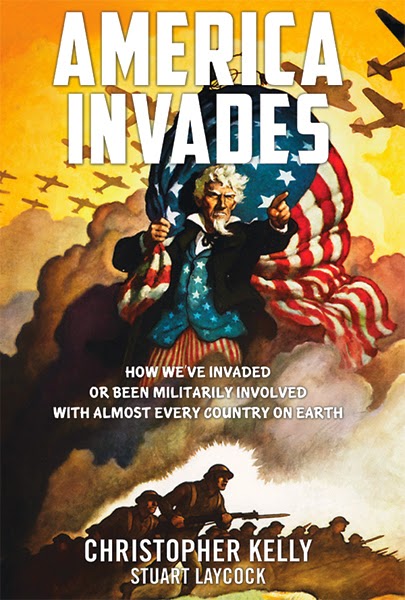


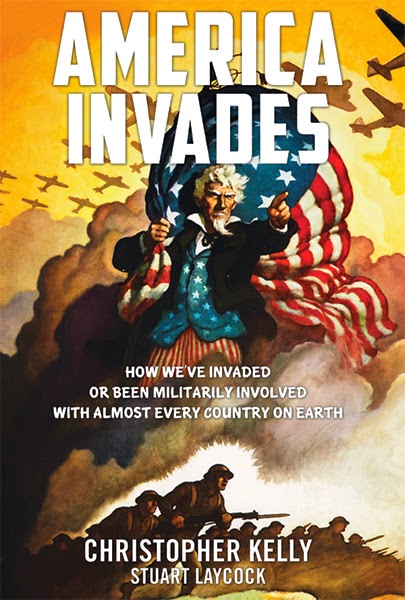
You can now purchase Commander Kelly's first book, America Invades here...www.americainvades.com or on Amazon...www.amzn.com/1940598427


Monday, June 10, 2013

London Under

Home of the Morlocks...?

Peter Ackroyd has written a slim volume on the subterranean history of London -- London Under (2011www.amzn.com/B004KPM16M).  All Londoners are aware of an astonishing second city of London that lies beneath our feet.

Descend below the surface and one will discover under London a shadow world filled with crypts, corpses, secret passages, transportation, treasure, bomb shelters, cellars, swimming pools and much more.  Ackroyd writes, "Good and evil can be found sure by side; enchantment and terror mingle.  If the underworld can be understood as a place of fear and danger, it can also be regarded as a place of safety."
Commander K. and Nelson
Crypt of St. Paul's, London
This shadow city of London that lies below the surface is an unknown world, a secret world.  In the crypt of St. Paul's (see earlier post http://americanconservativeinlondon.blogspot.co.uk/2013/05/st-pauls-cathedral.html) one will find notables buried such as the Duke of Wellington, Lord Nelson and Christopher Wren (http://www.stpauls.co.uk/Cathedral-History/Explore-the-Cathedral/Discover-the-Crypt).  Ackroyd informs us that "When Christopher Wren was digging below the remains of the Great Fire, he found Anglo-Saxon graves lined with chalk stone.  Saxon coffins of the same material lay beside them."
London Comedy, 1988
The title character in the hysterical comedy A Fish Called Wanda, played by Jamie Lee Curtischides the idiotic Otto, "Now let me correct you on a couple of things, OK? Aristotle was not Belgian. The central message of Buddhism is not "Every man for himself." And the London Underground is not a political movement."

Indeed it is not.  Ackroyd tells us that "The London Underground is an old system.  Its pioneer and prime mover (Charles Pearson) was born in the eighteenth century...Jack the Ripper (1888) could have travelled on the Underground to Whitechapel."
London Tube Map
Today the Tube whisks commuters, tourists, school groups and packs of "beastly" teenagers around London with surprising efficiency and reasonable cleanliness.  During the Zeppelin raids of the First World War and the Blitz in Second World war, Londoners sought refuge in the Tube stations and would sleep in the Underground.
London Underground / Slave Quarters?
During the Blitz
According to the historian Rick Atkinson, "Tens of thousands sheltered at night in the Tube, and the cots standing in tiers along the platforms of seventy-nine designated stations were so fetid that the sculptor Henry Moore likened wartime life in these underground rookeries to the 'hold of a slave ship'".  (Source: The Guns at Last Light, Rick Atkinson, 2013 www.amzn.com/0805062904).

"They had no choice."
Old black and white photos from World War II show the entrance of the Tube stations piled high with protective sandbags.  One can hardly imagine the assault on the olfactory sense created by the organic contributions of the hounds of wartime London to these sandbags, greeting all those who entered these sanctuaries.
Commander K. in Churchill's bedroom
Churchill War rooms, London
Under London visitors should seek out the Churchill War rooms (http://americanconservativeinlondon.blogspot.co.uk/2012/02/churchill-war-rooms.html) where the British Cabinet would meet during the Second World War to plot war strategy.  Winston Churchill (http://www.iwm.org.uk/visits/churchill-war-rooms) despised the necessity of spending time in the Cabinet War rooms -- his expansive personality was pinched by the cramped quarters.  In the Interactive Churchill Museum one can find locks of the ginger hair of his youth and a record of his schoolboy infractions and the beatings that resulted.  The rooms were sealed up after the war and nearly forgotten about for many years.

Even today cold war era bomb shelters and various secret military HQ's can be found beneath the streets of London.
Napoleon III, Museo Napoleonico, Rome
Emperor, Wine Champion, Refugee
A veritable "underground lake" of fine wine lies aging to perfection and, quite often, beyond in the cellars of wealthy Londoners.  Berry Brothers & Rudd (http://www.bbr.com/) was founded in 1698 and is England's oldest wine merchant.  Their store on St. James features wine tastings, dinners and other events in their "Napoleon cellar".   After his humiliating defeat in the Franco-Prussian war of 1870, Napoleon III escaped across the English Channel to London and threw himself upon the mercy of his wine merchant.  Napoleon III, having presided over the creation of the Bordeaux first growth classification system of 1855, had a reasonable expectation of succour from Berry Brothers.

Rich Londoners today are burrowing underground and adding subterranean square footage to their properties with garages, wine cellars, home theatres and even swimming pools.  A Canadian media mogul, for example, is adding four floors below ground to his home in Knightsbridge (http://www.dailymail.co.uk/news/article-2228782/David-Grahams-4-storey-Knightsbridge-mansion-entirely-underground.html).

Vast fortunes lie beneath our feet in London.  Ackroyd writes, "It is estimated that 250 million ounces of gold are concealed beneath the ground.  But no London cellar is more wonderful than the vaults of the Bank of England.  They contain the second biggest hoard of gold bullion ion the planet.  A network of tunnels, radiating out from the bank, run beneath the the City streets.  Several thousand bars of 24 carat gold, each one weighing 28 pounds, are stored within them.  They may be said to light up the bowels of the earth."

The SPDR Gold Trust (http://www.spdrgoldshares.com/usa/key-information/ ticker symbol GLD) has its physical gold -- an estimated 1,200 metric tons worth over $70 billion -- stored by HSBC in a secret London underground vault.  Bob Pisani of CNBC recently took viewers on a fascinating tour (see video below) of this glittering part of secret subterranean London.

The presence of so much treasure below the ground may help to explain the phenomenon of "the mole man," William Lyttle, who spent forty years digging 60 foot long tunnels beneath his property in Hackney.  "'Tunnelling', he said to journalists, 'is something that should be talked about without panicking.'"  (http://www.dailymail.co.uk/news/article-2176073/Run-home-mole-man-spent-40-years-digging-network-tunnels-underneath-sells-1-1million.html)

Peter Ackroyd's Notes from Underground London concludes that, "London is built upon darkness."  Commander Kelly says, "An exploration of the darkness below London's surface can be most illuminating."


Special thanks to Dom Driano Jr. for the gift of Atkinson's book The Guns at Last Light.


You can now purchase Commander Kelly's 
first book, America Invades here...www.americainvades.com or on Amazon...www.amzn.com/1940598427


Sunday, June 9, 2013

A Splendid Exchange


William Bernstein's book A Splendid Exchange: How Trade Shaped the World (www.amzn.com/B006NZ9XTU) is a wonderful follow up to his previous economic history The Birth of Plenty.  Bernstein has written a fascinating history of the phenomenon of trade.  His wit and sharp eye for detail make the "dismal science" more joyful and less dismal.

We tend to be too jaded about the enormous impact that trade has had on all of our lives.  We really need to rediscover the wonder of modern commerce.  As Bernstein writes, "televisions from Taiwan, lettuce from Mexico, shirts from China, and tools from India are so ubiquitous that it is easy to forget how recent such miracles of commerce are."  Trade has immeasurably enriched the lives of contemporary man, but how did this come to be?

Every nation faces what Bernstein calls "the basic 'trilemma' of trade -- to trade, to raid, or to protect.  Then, as now, how each government, form that of the humblest city state to that of the grandest empire, approached these three choices dictated the shape of the trading environment and, indeed, the fate of nations."

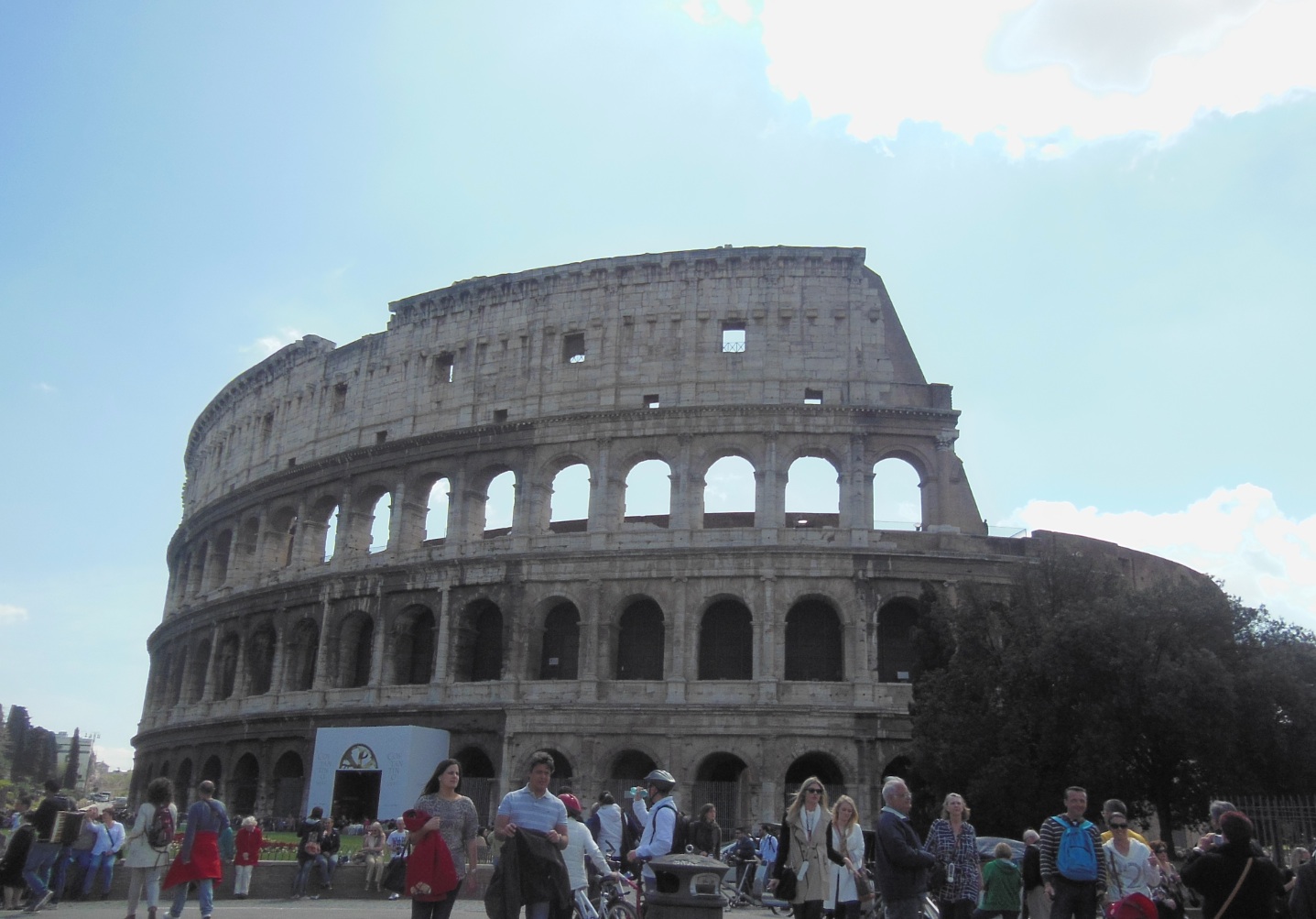
Colosseum, Rome
Built 70-80AD
The poet Juvenal, writing around 110 AD, complained of the luxury-loving women of ancient Rome  "who find that the thinnest of thin robes too hot for them; whose delicate flesh is chafed by the finest of silk tissue."  Wealthy Romans preferred to wear Chinese silk.  Roman roads and Roman armies created the Pax Romana which allowed trade to flourish throughout the Mare Nostrum -- the Mediterranean.

Outside of the Roman world, in areas such as Arabia, life could be much tougher.  Bernstein writes, "the harsh and lawless environment of the desert shaped both economic and religious life on the Arabian Peninsula and has to this day left its mark on the culture of the Muslim world  Survival in Arabia, with its lack of central authority, was, and remains utterly dependent on the good efforts of the family and the tribe.  Western notions of individual autonomy and rule of law simply do not apply in the desert.  An attack on one tribesman is an attack on all, and in a landscape where a murderer can quickly and quietly slip away, it matters little whether the accused is guilty or innocent.  His entire clan is held accountable for that -- retribution.  The resulting skein of honour and revenge, so familiar in the modern middle east, seemingly without beginning and without end."

Mohammad was a trader
Bernstein points out that "Alone among the world's religion's Islam was founded by a trader.  This extraordinary fact suffuses the soul of this faith and guides the historical events that ricocheted over the land routes of Asia and the sea-lanes of the Indian Ocean through the next nine centuries."

Bernstein surveys the expedition of the Venetian Marco Polo to China and back.  He chronicles the age of exploration and the vital role of the Portugese seafarers in charting new trading routes to Asia.  The expeditions of Columbus to the New World were designed to facilitate trade with the spice islands of the east.  This book is jammed full of fascinating historical tidbits such as this one about pigs -- "The Spaniards soon found the tossing a breeding pair of the animals onto a promising uninhabited island guaranteed abundance of pork there within a few years."

Bernstein's credo is that, "The instinct to truck and barter is part of human nature; any effort to stifle it is doomed to fail in the long run.  Ever since men first challenged the world's seas and deserts with ships and cables, they have carried with them tradable commodities.  At the dawn of the Common era, the extremities of civilised Europe an Asia new and coveted each other;'s luxury goods.  By the end of the nineteenth century, most of the features we consider peculiar to modern global commerce  -- instantaneous communication, long distance trade in bulk commodities  and perishable, and an intercontinental manufacturing cycle -- were well established.  Today's debates over globalisation repeat, nearly word for word in some cases, those of earlier eras.  Whenever trade arrives, resentment, protectionism, and their constant companions -- smuggling, disrespect for authority, and occasionally war -- will follow."


Commander K. under the Cutty Sark
Fastest Tea Clipper of its day
Trade is always a competitive endeavor in which winners and losers are both certain to emerge.  The inevitable minority of losers in our global economic competition have sometimes turned violent in the expression of their frustration; thus we witness the Luddites destroying manufacturing equipment in 19th century England and anarchists protesting the WTO (World Trade Organization) at the Battle of Seattle in 1999.  In our age of rapid technological change, the winners of today become the losers of tomorrow -- the fastest ship of its day, the Cutty Sark, is made redundant by the introduction of the Suez channel (see earlier post http://americanconservativeinlondon.blogspot.co.uk/2012/05/cutty-sark.html).

Trade has had a complex relationship with armed conflict over time.  Socrates, an old soldier himself, said, "All wars are fought for money." A sea-trading nation must, of necessity, become a naval power if only to police and protect the flow of commerce.  The raiding option in Bernstein's 'tri-lemma' continues to tempt the pirates of Somalia to this day.

Protectionist policies that seek to restrict free trade played a role in creating the conditions that led to the devastating wars of the twentieth century including the Second World War.  The French economist Frédéric Bastiat reportedly said, "When goods are not allowed to cross borders soldiers will."

Bernstein concludes his book with some surprising optimism about the relationship between trade and warfare.

"Life on earth is slowly becoming less violent, mainly owing to the increasing realization that neighbors are more useful alive than dead.  Those who doubt this rosy assessment should consider some data from the World Health Organization.  Their statistics show that in 2004, violence accounted for just 1.3 percent of the world's deaths, an all-time low, and that at the beginning of the twenty-first century the number of battle deaths per year has decreased to one-thirtieth of what it was in the 1950s.  This seems to be part of a longer-term historical trend; archaeological data suggest that upward of 20 percent of Stone age populations met violent deaths, a finding that is supported by research on modern hunter-gatherer societies."

Commander Kelly concludes, "Make trade, not war!"


Special thanks to Ken Curtis for bringing this book to my attention.


William Bernstein wrote that America Invades is "Simultaneously readable and reference material, destined to become the go-to for those who want to understand America's place--literally anywhere-- in the world.


You can now purchase Commander Kelly's 
first book, America Invades here...www.americainvades.com or on Amazon...www.amzn.com/1940598427


And now Italy Invades: How Italians Conquered the World...
or on Amazon...

Thursday, June 6, 2013

D-day + 69


Commander K. at Churchill War Rooms, London

Sixty-nine years ago today the Allies stormed ashore in the D-day landings on the Normandy coast of France.  The Americans landed on Utah and "bloody" Omaha beaches.  The British arrived on Sword and Gold beaches.  The Canadians landed on Juno beach.  The Rangers scaled up the cliffs of Pointe du Hoc and disabled the German guns which threatened the landings.  The American Airborne divisions (82nd and 101st) had landed the previous evening around midnight near St. Mere Eglise, while the British Paras secured Pegasus bridge.

The liberation of France began, not on June 6, 1944, but, in fact, in September of 1943 with the liberation of Corsica (http://americanconservativeinlondon.blogspot.co.uk/2012/05/corsica-in-world-war-ii.html).

Allied planes were painted with black and white "D-day stripes" to avoid friendly fire errors that had plagued the invasion of Sicily in 1943 (http://americanconservativeinlondon.blogspot.co.uk/2012/07/a-hard-lesson-from-world-war-ii-and-d.html).

James Doohan, who later became "Scottie" on the original TV series Star Trek, landed that day with the Canadian troops on Juno beach.  He was shot six times by friendly fire that evening, but survived  (http://americanconservativeinlondon.blogspot.co.uk/2012/07/james-doohan-and-d-day.html).


Billie Harris, piloting a P-51 Mustang, crashed and was killed in France leaving behind the last D-day widow on this day (http://americanconservativeinlondon.blogspot.co.uk/2012/07/last-d-day-widow.html).

The D-day spies managed to utterly fool the Germans into believing that the landings would take place at the Pas de Calais and not Normandy  (http://americanconservativeinlondon.blogspot.co.uk/2012/07/double-cross-d-day-spies.html).

Commander K. with B-17, Duxford
Last week Democratic Senator Frank Lautenberg died.  His primary legislative achievement was the introduction of a mandatory age 21 drinking age nationwide which is said to save many thousands of lives each year.  Lautenberg was the last US Senator who served (in the US Army Signal Corps) during World War II.
Dame Vera Lynn, born 1917
Vera Lynn, on the other hand, is, happily, still going strong at age ninety-six!  According to Billboard magazine, "In September of 2009, the 92-year-old Lynn became the oldest singer ever to top the British album charts, when a new Decca collection of her World War II recordings, We'll Meet Again: The Very Best of Vera Lynn, hit the number one spot, a doubly extraordinary achievement in light of the reissue of the entire Beatles catalog that same month."  (http://www.billboard.com/artist/430741/vera-lynn/biography) Vera Lynn, the wartime crooner, has struck a chord with music lovers in the 21st century.  In our age of anxiety and historical forgetfulness that is something to remember and be grateful for.

The month of June with its graduations, farewells, sunny days and D-day commemorations is the perfect time to enjoy Vera Lynn's We'll Meet Again.

Cheers from London!

Special thanks to David Michaelson for photographic assistance.


You can now find Commander Kelly's first book, America Invades,  here www.americainvades.com or on Amazon www.amzn.com/1940598427


Thursday, May 30, 2013

RAF St. Clement Danes Church

Commander K. at St. Clement Danes, London
Commander Kelly wrote earlier...

"There are a handful of things for which the entire world must remain forever grateful and indebted to the British people....the existence of William Shakespeare, the tradition of parliamentary democracy, the invention of afternoon tea and the performance of the RAF during the Battle of Britain."

St. Clement Danes, London
Another way to repay this last debt is, perhaps, with a visit to the RAF Church in London -- St. Clement Danes.  Here is their web site...www.raf.mod.uk/stclementdanes.   You will find the church in leafy part of London not far from the river Thames.  The nearest tube stop is Temple.
Interior of St. Clement Danes, London
St. Clement Danes has been the site of a Christian church since the ninth century.  Many Danish raiders decided to settle down and marry English wives in this part of London near the Thames.  St. Clement was the bishop of Rome in the First century who is reputed to have been martyred during a persecution of Christians under the Emperor Trajan; he was said to have been tied to an anchor and thrown into the sea.

Christopher Wren (see earlier post, St. Paul's Cathedral, 5/28/13) rebuilt the church from 1680-1682.

May 10, 1941
In 1941 the church received a direct hit from an incendiary bomb dropped by the Luftwaffe.  Only the outer shell of the church remained.

Organ at St. Clements, London
In 1958 the church was restored and consecrated to the RAF who had served with such valour in the Second World War.  Many brother Air Force services around the world assisted with the reconstruction.
Lord Dowding, London
In front of this church you will find a statue of Air Marshall Dowding (1882 - 1970) who prepared the RAF for the Battle of Britain.  Dowding was a classic British eccentric.  He was a vegetarian and a spiritualist who, like Patton, believed in reincarnation.  Sir Lawrence Olivier played him in the movie "Battle of Britain".

 The inscription on the statue above reads, "Air Chief Marshal Lord Dowding was commander-in-chief of Fighter Command, Royal Air Force, from its formation in 1936 until November 1940. He was thus responsible for the preparation for and the conduct of the Battle of Britain. With remarkable foresight, he ensured the equipment of his command with monoplane fighters, the Hurricane and the Spitfire. He was among the first to appreciate the vital importance of R.D.F. (radar) and an effective command and control system for his squadrons. They were ready when war came. In the preliminary stages of that war, he thoroughly trained his minimal forces and conserved them against strong political pressure to disperse and misuse them. His wise and prudent judgement and leadership helped to ensure victory against overwhelming odds and thus prevented the loss of the Battle of Britain and probably the whole war. To him, the people of Britain and of the Free World owe largely the way of life and the liberties they enjoy today."

Commander K. and "Bomber" Harris
You will also find a statue of Arthur "Bomber" Harris (1892 - 1984) nearby.  Harris led RAF Bomber Command (see earlier post, RAF Bomber Command Memorial London, 10/13/12) during the Second World War.  He was often wildly optimistic that strategic bombing alone could win the war.  The Queen mother was booed by anti-war protesters at the unveiling of this statue in 1992.

RAF POW Commemorative plate and Eagle.
Inside the church you will find poignant RAF mementoes of the war.  The above display commemorates the escape of RAF POWs from the "Great Escape" on March 25, 1944.  Serving in the RAF in WWII meant not just the likelihood of an early death, but also the possibility of a lengthy and unpleasant incarceration.

There is an ancient nursery rhyme about "Oranges and Lemons" associated with the church.

"Oranges and lemons" say the Bells of St. Clement's
"You owe me five farthings" say the Bells of St. Martin's
"When will you pay me?" say the Bells of Old Bailey
"When I grow rich" say the Bells of Shoreditch
"When will that be?" say the Bells of Stepney
"I do not know" say the Great Bells of Bow
"Here comes a Candle to light you to Bed
Here comes a Chopper to Chop off your Head
Chip chop chip chop - the Last Man's Dead."

RAF Pilot
Under the coat of arms above the church's altar you will find an inscription that sums it up well..."Built by Christopher Wren 1682.  Destroyed by the thunderbolts of air warfare 1941.  Restored by the Royal Air Force 1958".

Commander Kelly says, "Pause to Remember the Few from the Battle of Britain, the Many who also served and those who serve in the RAF today with a visit to St. Clement Danes in London."

For more entertaining history...Please Pre-order your copy of America Invades here...www.amzn.com/1940598427

You can also find more here...www.americainvades.com


You can now purchase Commander Kelly's 
first book, America Invades here...www.americainvades.com or on Amazon...www.amzn.com/1940598427


Tuesday, May 28, 2013

St. Paul's Cathedral

Reflections on St. Paul's 
St Paul's Cathedral is a mandatory stop on the American Conservative tour of London.  St. Paul's Cathedral (http://www.stpauls.co.uk/) is simply one of the greatest monuments in the world testifying to man's longing for proximity to the divine.  St. Paul's, located in the heart of the ancient City of London (the square mile), is one of the glories of England and a treasure of the world.

Commander K. and Lord Nelson, St. Paul's
The location of St.Paul's Cathedral has been a place of worship for Christians since the 4th century AD.  It continues in its mission as a vital place of mourning England's losses and celebrating her triumphs.  It is an unapologetically imperial church which holds the mortal remains of Lord Nelson (see earlier post, Horatio Nelson: Champion of Liberty, 1/15/12), the Duke of Wellington and General "Chinese" Gordon.

Thatcher Funeral, April 17 2013
Photo courtesy: Marc Leslie
Recently St. Paul's was the site of Margaret Thatcher's funeral (see earlier post, Margaret Thatcher RIP, 4/17/13).  You will find a plaque to all those who perished in the 1982 Falklands war.
Lord Nelson, St. Paul's, London
When Lord Nelson's funeral was held here in January 1806 the sailors who were charged with carrying his coffin tore the Union Jack flag into fragments keeping them as mementos.
Christopher Wren's monument
The present Cathedral was consecrated in 1708 and designed by the brilliant Christopher Wren.  It is built of Portland stone and was the first Anglican Cathedral.  Wren has this carved into the walls of St. Paul's...."Lector, Si Monumentum Requiria Circumspice" -- "Reader, If you need to see my Monument look around you."


While the Blitz was raging during World War II Winston Churchill and his war cabinet were often forced to go underground into the Cabinet War rooms (see earlier post, Churchill War rooms, 2/1/12).  When the "all clear" signal was flashed Winston would emerge from the depths and ask a simple question, "Is St. Paul's still standing?"  Churchill knew the iconic importance that St Paul's possessed for English-speaking people everywhere.  Churchill's funeral service was held here on January 30, 1965 (http://www.stpauls.co.uk/Cathedral-History/Cathedral-History/Cathedral-History-Timeline/1965).
The "Dirty Corner" of St. Paul's
When you visit St. Paul's you must also check out the "dirty corner".  St. Paul's received a thorough cleaning after its walls had been blackened by centuries of candle smoke.  They, however, left one small section uncleaned to show what a tremendous difference the cleaning made.  This is the "Dirty Corner" of St. Paul's.  The cleaning was largely paid for by members of the Fleming family, that is to say by relatives of Ian Fleming, the creator of James Bond (http://www.telegraph.co.uk/news/uknews/1384682/St-Pauls-reveals-a-fresh-new-look.html).  One can, therefore, say, with only slight exaggeration, that it was James Bond (see earlier post, Commander Bond's London, 2/23/12) who cleaned up St. Paul's and brought it to its current pitch of perfection.

Commander K. and Lawrence of Arabia
Another covert operative, Lawrence of Arabia (see earlier post, Lawrence of Arabia, 12/27/12) is commemorated here at St. Paul's.

"Modern Major Composer"
Arthur Sullivan of musical theatre fame is buried in St. Paul's Cathedral along with many other "modern major generals".

George Washington, St. Paul's
Distinguished Americans are also represented at St. Paul's.  George Washington (see earlier post, George Washington...in London? 2/8/12) never visited England but you can find his bust at St. Paul's.
Roll of Honour, St. Paul's, London
At the east end of the Cathedral you will find an American Memorial Chapel that was paid for by subscription by the British people (http://www.angelfire.com/my/mighty8thlh/CHAPELUK.html).  Here you will find the roll of honour -- a book containing the names of over 28,000 American servicemen who died in World War II and served in the UK.  St. Paul's offers a welcoming American Thanksgiving service every year.
American Eagle, St. Paul's, London
Commander Kelly says, "A visit to St. Paul's should be on everyone's bucket list!"

Special thanks to Mark Hansen.


This below is not actually from St. Paul's but seems, nevertheless, appropriate...


You can now purchase Commander Kelly's 
first book, America Invades here...www.americainvades.com or on Amazon...www.amzn.com/1940598427