2013 marked the centenary of the birth of Robert Capa -- the greatest war photographer of all time. Endre Friedman was born in Budapest on October 22, 1913. His father was a Jewish tailor. In 1931 he moved to Berlin to study journalism. After Hitler's accession to power in 1933 he fled the "garden of the beasts" and eventually wound up in Paris. In 1936 he changed his name to "Robert Capa" and arrived in Spain to cover the civil war. In Paris he met the great love of his life, Gerda Taro; she would later be killed in the Spanish civil war while working as a war photographer.
"Moment of Death"
During the Spanish civil war he took the famous "moment of death" photograph that launched his career. This photograph remains controversial to this day with contemporary war correspondents and photographers. The perfection of this violent image invites the insidious question: "Could it have been staged?"
In the book Frontline: Reporting form the World's Deadliest Places David Loyn writes, "Ever since doubts were raised over Robert Capa's 'moment of death' photograph, which appears to show a soldier as he is hit by a bullet in the Spanish civil war, war photography has been under scrutiny. The evidence for Capa's picture being exactly what it looks like is strong, but doubts remain. It is easier to sit in a bar and retell rumour and suspicion than it is to go out and put your life on the line to take real pictures. Nobody can say what pictures show except the person who took them; interpretation comes down to trust." (Source: Frontline: Reporting form the World's Deadliest Places, David Loyn, 2011, www.amzn.com/1849531412)
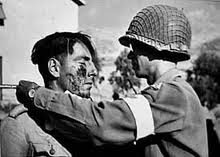
In 1937 Capa made his first visit to the United States. By 1943 he was an accredited war correspondent in the US Army. He would document the campaign in Tunisia, Sicily, Italy and the D-day Landings. The opening 20 minutes of Spielberg's Saving Private Ryan are an homage to Robert Capa's work as well as a tribute to the heroes who fought on June 6, 1944.
German POW and US Army medic, Sicily 1943
The immediacy and impact of World War II photography, including Capa's, was far greater than the photography of the First World war, just as the films of the 1940s are more memorable than the films of the silent era.
Omaha Beach, June 6, 1944
Capa's war photography made him a famous celebrity. He had a two year relationship with Ingrid Bergman beginning in 1945.
Siclian peasant and US Officer, Sicily 1943
"The Germans went that-away!"
Capa was ever a gambler, a risk taker. He loved to play cards and attend horse races. His motto was, "If your pictures aren't good enough, you aren't close enough."
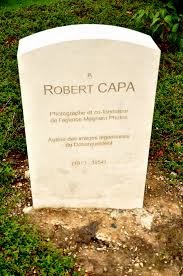
Capa's grave, Amawalk, NY
In 1954 Capa went to cover the grim siege of Dien Bien Phu in Vietnam. He stepped on a landmine and was killed at the age of 40. He is now buried at the Quaker cemetery at Amawalk in the USA.
American GIs at Maria SS Assunta Cathedral, Troina, August 6, 1943
Consider the political trajectory of Capas's life. He was born into the dying days of the Austro-Hungarian empire. In his youth he moved in largely socialist circles and was briefly imprisoned by the Hungarian secret police. He went to University in Weimar Germany. He fled to Paris to escape persecution in Hitler's Germany. His first photographic success was in reporting for the Spanish civil war -- the most ideological war of the 20th century. His unforgettable photos helped turn ordinary GIs into heroes for the US Army. He adopted the USA as his home. Finally, he was killed by a communist landmine becoming the fist American casualty of the Vietnam war.
Source: Robert Capa: in Italia, 2013, Fratelli Alinari, Beatrix Lengyel, Eva Fisli.
Travel Notes: From now until February 23, 2014 you can see an exhibition of Capa's Italian war photography at the Museo Nazionale Alinari Della Fotographia (Alinari National Museum of Photography). The museum is in Florence, Italy.www.alinarifondazione.it. Piazza Santa Maria Novella 14a/r, 50123 Florence, Italy.
The greatest visual artist of the 20th century was not Picasso or Matisse; the greatest visual artist of the 20th century was a London greengrocer's son by the name of Alfred Hitchcock. This view is based not merely on the massive quantity of impressions that he was able to generate in a lifetime devoted to film but, more importantly, based on the quality and vision of those images.
Some men are able to see their way around Time's corners better than others. In 1888 Nietszche foresaw the catastrophic wars of the 20th century writing, "All the mighty worlds of the ancient order of society are blown into space—for they are all based on lies: there will be wars the like of which have never been seen on earth before." (Source: Ecce Homo, Friedrich Nietzsche www.amzn.com/0199552568). Winston Churchill, another man of vision, foresaw the coming devastation declaring before World War I, "A European war can only end in the ruin of the vanquished and the scarcely less fatal commercial dislocation and exhaustion of the conquerors...The wars of peoples will be more terrible than those of kings." (See earlier post "Young Titan"... http://americanconservativeinlondon.blogspot.com/2013/12/young-titan.html). America'sGeneralPatton predicted the Japanese attack upon Pearl Harbor in a report prepared in 1937 (see earlier post "Patton Quotes"...http://americanconservativeinlondon.blogspot.com/2012/08/patton-quotes.html).
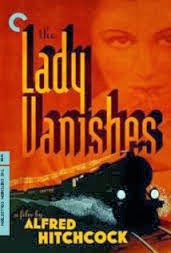
Hitchcock also had this visionary gift and it is on full display in his English masterpiece, The Lady Vanishes (www.amzn.com/B000VARC28). Hitchcock had a talent for turning the dross of literary pulp fiction sources into cinematic gold.
The Lady Vanishes is a Romantic espionage thriller that was made in 1938 just as Peace itself was about to vanish from the face of Europe. This was the year of Chamberlain's infamous appeasement in Munich which doomed Czechoslovakia to seven years of ruthless Nazi domination. Most of the action of the film takes place in the fictional mountainous country of Bandrika. An avalanche has stranded the mostly English characters in a picturesque mountain resort. Most of the natives seem friendly, but Mandrika has a propaganda minister and people have a nasty habit of disappearing.
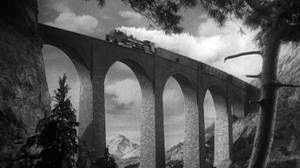
"It's only a model."
Soon the characters, forming a microcosm of English society, are gathered on a train hurtling through the winter chill. The young and beautiful heroine, Iris Henderson (Margaret Lockwood) and Gilbert, her musicologist love interest, encounter a sinister Dr. Egon Hartz (Paul Lukas) who tends to spout Freudian psycho-babble.
"Miss Froy" (Dame May Whitty) is the elderly, but surprisingly spry governess, who "vanishes" from the train. There is far more to Miss Froy than her mundane appearance suggests. She is, in fact, a British spy who carries in her head a musical tune which contains a vital secret code. The code contains information about a secret pact between two nations. This code must reach those in Whitehall but Miss Froy mysteriously vanishes from the train. The Hitchcockian "MacGuffin" in this film, therefore, anticipates the Nazi-Soviet pact that shocked in the world when it was announced in 1939.
Hitchcock's vision was not only accurate, it was decidedly Conservative as well. Hitchcock was an observant Roman Catholic who had a deep conviction about original sin. The primary victim in Psycho (www.amzn.com/B003IWZ1D8), played by Janet Leigh, is also a thief.
Hitchcock reveals a thoroughly Conservative skepticism about the nature of politics and politicians. Miss Froy coyly declares "You shouldn't judge any country by its politics. We English are quite honest by nature." The source of life's main joys are based on personal relationships and NOT ideology or political conviction.
There is this exchange between the villainous Dr Egon Hartz and Gilbert: "l am Dr Egon Hartz of Prague.You may have heard of me. -Not the brain specialist? -The same. You went to England to operate on one of our cabinet ministers...? -Yes. -Did you find anything? -A slight cerebral contusion. -That's better than nothing." In his personal life, Alfred Hitchcock was as conventionally heterosexual as Phil Robertson of Duck Dynasty. The symbolism of a train entering a tunnel in the concluding scene of North by Northwest (www.amzn.com/B0017HMF6W) is unmistakable. Hitchcock's romantic thrillers were, in fact, the aphrodisiacs of their time. How many baby boomers around the world were conceived after their parents had viewed one of Hitchcock's films?
Yet Hitchcock's attachment to traditional values did not make him a homophobe in any way. He would later cast Anthony Perkins in the title role of Psycho. In The Lady Vanishes two Englishmen, (Charters and Caldicott), both terrified of women, are, arguably, the happiest couple in the film. The sympathetic portrayal of a "gay" cricket-obsessed couple becomes the comic highlight of this film. When the chips are down, these men prove to be patriotic Englishmen who do not hesitate to use force to defend themselves. The Charters and Caldicott characters clearly foreshadow the role that the homosexual Alan Turing would soon play in decryption technology and the development of computing at Bletchley Park. The British government's beastly treatment of Turing after the war offers further confirmation of Hitchcock's Conservative view that government is filled with "empty-headed" cabinet ministers.
The climactic conclusion of The Lady Vanishes reveals Hitchcock as a patriotic Englishmen who was justifiably anxious about his country in 1938. On later emigrating to Hollywood, he would become a patriotic American (consider North by Northwest and Topaz).
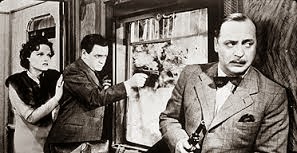
The path of appeasement which Chamberlain charted at Munich in the same year that this film was released is decisively rejected by Hitchcock. The faithless Mr. Todhunter (Cecil Parker) represents those in Britain who were drawn to appeasement. After the train is halted a gun battle breaks out between the English passengers and the Bandrikan police led by Dr Hartz. Todhunter declares, "l won't be a party to this sort of thing. l don't believe in fighting." Significantly, the word "Tod" means "death" in German and Todhunter races to his own destruction.
Margaret Lockwood, Naunton Wayne and Basil Radford
Ironically, the gayest character in Hitchcock's oeuvre, (Caldicott played by Naunton Wayne) rebukes Todhunter, "Pacifist? Won't work. Christians tried it and got thrown to the lions." Charters and Caldicott bear some striking similarities to the contemporary gay Conservative artists Gilbert and George (http://americanconservativeinlondon.blogspot.com/2012/03/new-faces-of-conservatism-gilbert-and.html).
Todhunter, an adulterer, bolts from the train and is shot by the Mandrikan police while waving the white flag of surrender.
It is clear from The Lady Vanishes that Hitchcock foresaw an "avalanche" of bad political news headed Britain's way in 1938. English democracy would be forced to confront the menace of fascism which sought its destruction. Some of those in Britain's diverse and free society would be tempted by the false lure of pacifism.
Finally, Alfred Hitchcock was a visionary artist with a Conservative temperament who foresaw...
1) The coming war or "vanishing" peace.
2) The vital role that would be played by women in the intelligence services. Maya (Jessica Chastain) in Zero Dark Thirty (www.amzn.com/B00B1E6FF8) is a direct descendent of Hitchcock's Miss Froy.
3) The contribution of gay English patriots to the cause of freedom (Alan Turing).
4) The folly of appeasement, pacifism and isolationism.
5) The Nazi-Soviet pact of 1939 (Molotov - Ribbentrop agreement).
Commander K. and Napoleon
Hyde Park Station, London
Before bidding a final adieu to 2013 it may be fitting to acknowledge some significant military anniversaries.
Napoleon I, Elba
I)BATTLE OF LEIPZIG, October 16 - 19, 1813
This year marks the bicentennial of the Battle of Leipzig. At this battle, also called the Battle of Nations, fought in Eastern Germany Napoleon faced armies from Austria, Russia, Prussia and Sweden. In the course of the four day affair some of Napoleon's Saxon allies actually switched to the Allied side. The disastrous campaign in Russia in 1812 had killed 370,000 of La Grande Armee with a further 200,000 captured. The recruits of 1813 were young and inexperienced soldiers. In addition, 200,000 horses had been killed in Russia devastating the French cavalry force.
Battle of Leipzig, Re-enactment 2013
Napoleon commanded a force of 225,000 including Germans, Poles and Italians as well as French forces. The Allies outnumbered Napoleon with 380,000 troops and far better cavalry. Leipzig marked the largest battle ever fought in Europe until World War I. One of Napoleon's favorites, Prince Poniatowski, was drowned while crossing the Weisse Elster river in the retreat that followed the battle. He had been made a Marshal of France the day before his death.
Napoleon's defeat in 1813 was also a blow to the fledgling American Republic who were fighting the War of 1812 (http://americanconservativeinlondon.blogspot.com/2012/04/war-of-1812.html) with Britain at the time. Napoleon was the de facto ally of President Madison and his defeat at Leipzig forced the Americans to sue for peace or face a reinforced British Army redeploying from the Peninsular campaign. The War of 1812 was a highly partisan war which divided Americans on political fault lines; Britain was New England's greatest trading partner. The Governor of Massachusetts, Caleb Strong, actually tried to negotiate a separate peace for his state.
Italian Campaign
II) ITALIAN CAMPAIGN
In July of 1943, seventy years ago, Allied forces invaded Sicily beginning the Italian campaign. This was the start of a brutal slog up the length of Italy. The Mountainous terrain worked to the advantage of the Axis defenders in slowing the Allied advance up the boot of Italy. The Germans were led by "smiling" Albert Kesserling, arguably the ablest Wehrmacht commander of the war.
Rick Atkinson's work, The Day of Battle (www.amzn.com/080508861X), is a masterful history of the Italian campaign.
Profligate waste characterized the entire Italian campaign. In the initial invasion of Sicily many Americans were killed by friendly fire due to trigger happy anti-aircraft gunners in the Allied naval forces (http://americanconservativeinlondon.blogspot.com/2012/07/a-hard-lesson-from-world-war-ii-and-d.html). An Axis air raid of Allied occupied Bari resulted in the sinking of a merchant ship loaded with mustard gas. Hundreds of Italian civilians and Allied soldiers died from exposure to the poison. The ancient monastery at Monte Cassino was destroyed by Allied bombing which killed monks and civilian refugees.
Rome was finally liberated on June 4th, 1944 but the news was quickly overshadowed by the D-day landings in Normandy. Though more Allied soldiers died in the Italian campaign than in the campaign in northwestern Europe, veterans who served there received scant credit and even became known as the "D-day Dodgers".
III) IRAQ WAR
2013 also marks the tenth anniversary of the US-led invasion of Iraq. Partisanship continues to be the prism through which many view this recent conflict.
Those on the left tend to decry it as being an unnecessary or "dumb" war. They view it as a distraction from the Global War on terror and the war in Afghanistan. They charge that Saddam had no direct link to Al Qaeda or Osama Bin Laden. They point to the war's enormous cost in terms of lives and treasure. They point to the botched occupation and the bloody insurgency that followed the invasion. They point to the catastrophic intelligence failure of the CIA in the lead up to war and the failure to find WMD in Iraq. Some even allege that it was a mercenary war for oil.
Deluded Power, Patty Warashina
Those on the right, however, remind us that Saddam did indeed have direct links to terrorism, if not to Al Qaeda. Abu Nidal took refuge in Baghdad. Saddam tried to kill George HW Bush on his trip to Kuwait (Source: http://hnn.us/article/1000). Saddam also paid cash bounties to the families of suicide bombers throughout the Middle East. The rising price of oil which leapt from just over $30 a barrel in 2003 to almost $140 five years later would have allowed Saddam's gangster regime to finance far more destructive terrorist plots.
We tend to suffer from a surprising forgetfulness or historical amnesia about even the recent past. We complain about the rhetorical brick-bats that Iran hurls at the state of Israel (Ahmadinejad: "Anybody who recognizes Israel will burn in the fire of the Islamic nation's fury."), but we seem to forget the actual SCUD missiles launched at a reluctantly neutral Israel that killed civilians in the first Gulf War in 1991. In all, 38 Iraqi missiles reached Israel, killing two and wounding 230 people (Source: http://drum.lib.umd.edu/bitstream/1903/4282/1/1993-Nature-Scud.pdf)
Commander K., 221 B Baker Street, London
Saddam did indeed have WMD in Iraq (http://americanconservativeinlondon.blogspot.com/2013/09/wmd-10-years-on.html). He used them against the Iranians in the 1980s and also against his own people. Thousands of Kurds were killed in northern Iraq. One does not have to be a Sherlock Holmes to realize that these weapons were either degraded, destroyed or moved to other nations such as Syria before the 2003 invasion. Part of Saddam's arsenal may have been employed by Assad in Syria this year.* Even Saddam's own General officers were unaware the dispositions of his WMD.
In considering the cost of the war it is also well to bear in mind the tremendous cost of NOT acting in Iraq.
1) Saddam could have used oil money to finance more terrorism and to develop its nuclear and biological capability.
2) Qaddafi's subsequent removal from Libya would have been far more costly had he retained his stocks of WMD that were disposed of in Tennessee.
3) Kuwait, Saudi Arabia, the Gulf States and Israel would all lie under immediate threat from a much more potent Iraq.
4) The world would not have witnessed the sight of a brutal dictator being toppled and put on trial by his own people.
5) The purple fingers of Iraq's experiment with representative democracy would never have helped to inspire the Arab Spring which has spread the winds of change throughout the Muslim world. Toppling Saddam in Iraq was the often unacknowledged sine qua non of the Arab spring.
Commander Kelly concludes, "War is always wasteful; it is also, however, the surest means of removing despots such as Napoleon, Hitler and Saddam Hussein. When the fires of partisanship eventually die down perhaps history will be kind to George W. Bush after all..?"
HAPPY NEW YEAR TO ALL!
* Sarin gas degrades over weeks or sometimes months. It is interesting to note that the poison satchel made for Napoleon in case of capture in the 1812 invasion of Russia merely made him wretch after he swallowed it in 1814 after his defeat in France.
Commander K. + Wellington
Hyde Park Station, London
Apsley House (http://www.english-heritage.org.uk/daysout/properties/apsley-house/), built between 1771 and 1778, was the home of the First Duke of Wellington (1769 - 1852) and remains a residence of the Duke of Wellington to this day. This gem of a house has a fitting address -- "Number One London". Wellington, rewarded by many of Europe's crowned heads, amassed an outstanding collection of fine paintings.
The Duke hosted annual Waterloo dinners each year for the officers who had served with him on that fateful day. A marvellous silver gilt service that was a gift to Wellington from the Portuguese dominates the room. Before Waterloo Wellington fought and defeated Napoleon's Marshals in the Peninsular campaign from 1809 to 1814. In Portugal Wellington had the Lines of Torres Vedras constructed to defend Lisbon from the French.
Commander K. with Napoleon
Hyde Park Tube Station, London
After his defeat at Waterloo Emperor Napoleon was sent to exile on the barren isle of St. Helena. He died, likely of stomach cancer in 1821.
Commander K. at Apsley House
Napoleon and Wellington had much in common. Both men were born in 1769 on islands (Corsica and Ireland) under the thumb of their more powerful imperial neighbors (France and England). Both pursued highly successful military careers which culminated in political power. Both very were voraciously heterosexual and neither man enjoyed a happy marriage. They even shared two mistresses -- the Italian singer Grassini and Mademoiselle George. The later judged that, "Monsieur le duc etait de beaucoup le plus fort" (The duke was much the stronger).
Duke of Wellington fights a duel
Battersea Park, London
Wellington, on the other hand, returned to England where he later became Prime Minister. In 1829 he fought a duel at Battersea park against the Earl of Winchelsea who opposed Wellington's support of Catholic emancipation. No one was injured.
Commander K. and the Duke, St. Paul's, London
Wellington''s older brother helped him advance early in his career. Andrew Roberts writes that, "A combination, therefore, of nepotism, racism and snobbishness - all anathema to twenty-first century liberal society -- saved Europe from despotism." (Source: Napoleon and Wellington, Andrew Roberts, 2001www.amzn.com/B004GHN2VC)
William Funk USMC at The Grenadier, London
After a visit to Apsley House, be sure to drop by The Grenadier pub which is nearby on 18 Wilton Row in Belgravia. Wellington's officers used it as a mess in his time. Try the Beef Wellington which is excellent! They even have ghost! Here is the link...
The Second World War was the most costly manmade catastrophe in human history. This conflict killed over 60 million people around the globe. At the heart of this terrible war lies a mystery that remains, at least to some extent, unsolved even after seventy years have passed. Bletchley Park yielded up her secrets long ago. Why not the Hess flight to Scotland? It is the ultimate spy story played for the highest possible stakes.
Hess' BF 110, Imperial War Museum, London
Consider first the curious timing of this event. Hess, the deputy Fuhrer of the Third Reich, took off in an ME-110 from Germany to Scotland on May 10 1941. Up until this point in the war, the Axis had experienced only success. Just a few weeks after the Hess flight on June 22 Hitler would launch Operation Barbarossa, the disastrous invasion of the Soviet Union. After the Hess flight, the Axis forces would experience no more strategic victories. The Hess flight truly was, as Peter Padfield puts it, "The real turning point of the Second World War".
Hess was a curious specimen of humanity (see earlier post Rudolph Hess...http://americanconservativeinlondon.blogspot.co.uk/2013/01/rudolph-hess.html). He was a German who had been born in a colony of the British Empire -- Egypt. He grew up a German expatriate in comfortable circumstances, the son of a successful businessman.
Hess was, like Hitler, a veteran of the First World War. He was a courageous German soldier earning the Iron Cross, 2nd class. After the war he met Hitler and his life was changed forever.
Padfield writes, "Hess loved Hitler. That is the essential key, without which his life story becomes incomprehensible." Even years after the Fuhrer's sell-inflicted demise when Hess was languishing as the sole inmate in Spandau prison he was still infatuated the man who had brought Gotterdamerung to Germany.
Commander K. at Tower of London where Hess was first held
What unsolved mysteries remain about the Hess gambit?
1) First, was Hitler in on the Hess conspiracy? Padfield assembles plausible evidence which would suggest that he did. Hitler's temper tantrum on "learning" of the Hess flight may have been mere play-acting at which the Fuhrer was quite talented.
2) Second, did Hess bring with him a written peace proposal with specific concessions that the Nazis were willing to make in order to assure that they would have "a free hand in the east" to invade the Soviet Union? Padfield cites convincing evidence that there was such a document. "MI5 files released recently show that on 14 May Censorship intercepted photostat copies of a letter Hess had brought with him". but that its contents, held by the British government, remain secret to this day.
3) Third, if the answer to 2) is "yes," then what exactly did it contain? Padfield's account necessarily relies upon the word of "anonymous informants". According to these sources, Hitler was offering to give up nearly all of his conquered territory in the West with the exception of Luxembourg and Alsace Lorraine. Padfield further speculates that Hitler may have used the issue of the Jews as a bargaining chip or ransom demand to enforce acceptance of his terms. The final solution or else. This would explain why such an incendiary document might remain buried even to the present.
4) Fourth, Padfield suggests that Hess was likely to have been the victim of an MI6 plot to embarrass the Nazi regime. There was a British "Peace"party in 1941, but the Duke of Windsor had been exiled to the Bahamas and Churchill was, thankfully, in control of the reigns of government. Extreme measures had been taken; habeus corpus was suspended. Oswald Mosley, the leader of the British Union of Fascists and a "Peace" advocate, was arrested on May 22, 1940 and imprisoned for the war's duration. Churchill immediately had Hess incarcerated (initially at the Tower of London) to await trial for war crimes and the Peace plot was foiled. While many historians and commentators have questioned Churchill's strategic judgement he got it right on the big things. As the South African statesman Jan Smuts said of Churchill, "in great things he is very great, in small things not great."
5) Fifth, Padfield dismisses the conspiracy theories that Hess may have been murdered in Spandau prison rather than hanging himself at the age of 93 with an extension cord. The suicide note seems plausible and the surveillance in Spandau prison makes assassination highly unlikely.
Could Hitler have prevailed in a war against the Soviet Union without Britain and the United States? This is a truly terrifying scenario but the answer is probably "yes". Although 4 out of 5 German soldiers were killed on the Eastern front that does not really tell the complete story. The Allied campaign in North Africa in 1942 captured more Germans than those that surrendered at Stalingrad that same year. Allied strategic bombing attacks meant that the Red Air Force would enjoy air supremacy on most of the eastern front. Billions of dollars worth of Allied lend lease supplied the Red Army with jeeps, trucks, boots, food and much more. Second fronts were opened by the Allies in Italy in 1943 and in France in 1944. Nor did the Soviets have to face the Imperial Japanese forces until the closing days of the war.
Commander K. with friends
Every Christmas season we celebrate the birth of the "Prince of Peace". The strange case of Hess reminds us that even Peace itself can be used as a weapon of war for the treaty that he likely brought would have been "a Peace to end all Peace". Hess was the world's first "peace-monger" (see earlier post...http://americanconservativeinlondon.blogspot.co.uk/2013/01/rudolph-hess-peace-monger.html).
Have we not seen "Peace used as a weapon of war" in the 21st century as well...? Could that not also describe Putin's recent intervention in Syria?
If you enjoy reading spy stories where the fate of the world is at stake look no further than Peter Padfield's Hess, Hitler and Churchill, The Real Turning Pint of the Second World War -- A Secret History, (www.amzn.com/B00CKD970Y).
Nelson Mandela died this week at the age of 95. Mandela deserves enormous credit for South Africa's peaceful transition from Apartheid to Democracy. He believed that the cycle of violence can be broken only by forgiveness. Only this way can we achieve peace. He forgave his jailers after spending nearly 30 years behind bars in South Africa's apartheid regime. Mandela won the 1993 Nobel Peace Prize. He also learned to loved rugby.
These things are known to all, but Commander Kelly has a somewhat different perspective on Nelson Mandela.
Mandela was born into a royal family in Africa. Both his parents were illiterate, but they wanted their son to receive a western style education. It was a teacher that gave him the name "Nelson" after his baptism into the Methodist faith.
"Nelson" was, of course, a reference to Lord Horatio Nelson -- the greatest naval commander of all time. It was Nelson's decisive victory at the battle of Trafalgar against the Franco-Spanish fleet that gave the Royal navy world wide naval supremacy for more than a century. Wise laws are useless if unenforced and it was the Royal Navy that enforced the Slave Trade Act of 1807, just two years after Trafalgar (see...Horatio Nelson Champion of Liberty http://americanconservativeinlondon.blogspot.co.uk/2012/01/horatio-nelson-champion-of-liberty.html.
Nelson's column, Trafalgar Square, London
Bronze Relief made from melted French canons
If you visit Nelson's column in London and regard the bronze relief featuring the death of Nelson. Please note the African sailor on the left holding a musket. Lord Nelson has just been fatally shot. The African sailor is looking up into the rigging in the direction of the perfidious French soldiers that have killed his admiral.
There were 22 Americans on board HMS Victory at the battle of Trafalgar, also one Jamaican, 4 West Indian and one African. It was a rainbow crew that triumphed that day.
Consider also the year of Mandela's birth - 1918. A momentous year that marked the end of the Great war. This year also marks the near apogee of the British Empire into which Mandela was born. In 1918 the Royal Navy was one of the most powerful institutions on earth. In 1918 the Royal Navy alone among the world's navies had aircraft carriers. (see...http://americanconservativeinlondon.blogspot.co.uk/2013/10/fleet-air-arm-museum.html).
1918 was only about 16 years after the conclusion of the Second Boer war which raged from 1899 to 1902. The last years of Queen Victoria's reign were marked by a rebellion against British rule by the Afrikaans of South Africa. The Boers were excellent hunters and marksmen who knew their homeland and used hit and run tactics inflicting many casualties on the British.
The rebellion was eventually put down with all the tools in the Imperial arsenal. Troops were brought from the far corners of the Empire. Maxim guns were employed foreshadowing the horrors of WWI trench warfare.
The Boer war represented a great stain on Britain's Imperial honor as it marked the invention of the concentration camp. Many Boer civilians including women and children (over 22,000 under 16 years of age) would perish in these hideous camps due to disease and starvation. In addition over 14,000 Black Africans died in the camps as well. Many Americans were sympathetic to the Boer cause and volunteered to join their fight against the British.
It was the bitterness of the Boer defeat in this war that helped mould the Afrikaan character, developing a stubbornness that Mandela would encounter in dealing with the Apartheid regime years later. South Africa would fight alongside the British in two World Wars in the 20th century but would pursue its own path apart from the Commonwealth after 1945.
Mandela spent 18 years on Robben Island imprisoned by the Apartheid regime. For many years he was forced to break rocks in the sun. He chose to study the Afrikaan language.
Who does Mandela remind us of...?
There was another man who had been born into a noble family with lofty expectations in a different corner of the British Empire. There was another man who, years before, had spent time as a prisoner of the Boers. He, however, had the good fortune to escape. This man too was a great statesman who won a Nobel prize, though his was for literature. This man too had a direct connection to and love for the Royal Navy. He persevered against extreme adversity. He even allied himself briefly with Communist dictators whose views he deplored. This man too fought for human freedom and triumphed. After attaining victory, he too preached the necessity for magnanimity. His name was...Winston Spencer Churchill.
In these days of hyper-partisanship where "true believers" of all stripes seem to be intent upon annoying the rest of us, it is well to recall the lesson of Winston Churchill's extraordinary life. We Americans, Democrats and Republicans alike, need to be reminded that greatness can spring, not always from a log cabin, but even from a palace (http://americanconservativeinlondon.blogspot.co.uk/2012/06/blenheim-palace.html).
Winston Churchill was not a religious man in the conventional sense of the term. After attending a rare service near his home at Chartwell the local rector remonstrated, "Well, Prime Minister, you are not quite a pillar of the church, are you?”
“No,” replied Churchill, “I’m not a pillar. I’m a buttress. I support the church from the outside."
Nor was his loyalty to political parties unquestioning, unwavering or conventional; quite the contrary, he changed party affiliation twice moving from Conservative (Tory) to Liberal and later back again. Churchill straddled a lifelong ideological divide; he was a Conservative by instinct intent upon preserving Britain's Imperial glory who was also a zealous reformer believing that government policy could effect positive change in the lives of its citizens. His wartime government was a cabinet of ALL major British parties. Clement Atlee of the opposition Labour party served as the Deputy Prime minister in Churchill's government during the war.
The thesis of late Victorian Imperialism and the antithesis of the Edwardian Liberal Reform movement received a Churchillian synthesis: The British Empire with it rule of law and free trade represented the best interests of humanity, or at least the one quarter of humanity that resided within the pink bits of the world map.
An early advocate of free trade, Winston fell out with the protectionist Joseph Chamberlain who had been an early Conservative patron of his. Joseph Chamberlain was the father of Neville of appeasement fame. Churchill crossed over to the other side of parliament to stand beside Lloyd George, leader of the Liberal party.
Nevertheless, Churchill was not a man lacking faith or conviction. Churchill's faith was four-fold. The first pillar of Churchill's faith was an unshakable patriotic devotion to King and Country. He had, after all, risked his life as a cavalryman at the battle of Omdurman where he slew the enemies of Queen Victoria with a German Mauser. A visitor to London can see this gun at the Churchill War Rooms http://americanconservativeinlondon.blogspot.co.uk/2012/02/churchill-war-rooms.html). The adventures of his youth are best told in his own classic autobiography, My Early Days (www.amzn.com/0684823454). Churchill's story is ably continued by Michael Shelden's Young Titan: The Making of Winston Churchill, published in 2013 (www.amzn.com/1451609914). Young Titan takes Churchill from his return from the Boer war to the conclusion of the Great War.
Churchill, Parliament Square, London
The second pillar of Winston's faith was his steadfast devotion to the cause of democracy. Churchill famously said that "It has been said that democracy is the worst form of government except all the others that have been tried".
In May of 1941 the Luftwaffe was raiding London on a nightly basis. One spring night fires broke out at Westminster Abbey and shrapnel struck the tower of Big Ben. Shelden writes, "Soon flames were sweeping through the debating chamber of the House of Commons. Its roof fell away, the galleries collapsed, and ashore if twisted steel and masonry buried the rows of green leather benches where so many famous debates had raged over the decades. Only the scorched walls were left standing." Churchill lamented, "Our old House of Commons has been blown to smithereens."
Churchill paid a visit to the devastated site that had been the home to the oldest parliamentary democracy in the world. "Now, as he surveyed the damage of that fiery Saturday night, tears began to trickle down his cheeks, and then to slow. 'He did not try to stop them,' noted a reported standing nearby, or even wipe them away.' Motionless in the sunlight -- one hand in his overcoat, his feet planted firmly on amount of rubble -- he looked for a second like a statue that had miraculously survived the bombing."
Churchill, true to his bedrock Conservative instincts, insisted that, "The Chamber must be rebuilt -- just as it was." And so it was. Source: Young Titan: The Making of Winston Churchill, Michael Shelden, 2013 (www.amzn.com/1451609914)
WSC stepping out
The third pillar of his faith, tested by many setbacks and reversals over his long life, was his belief in himself and his destiny. Born in a grand palace, he confided that, "the stars in the courses guided my progress." Churchill also said, "We are all worms. But I do believe I am a glow-worm."
Shelden's book does not focus on the well-known Churchill of the World War II, but rather his early formative years in politics from 1900 to 1918.
For much of this time Winston was a bachelor. The young Churchill was comically unlucky in love, falling in love with and being rejected by a series of beautiful and prominent women: Pamela Plowden who became Lady Lytton, the American actress Ethel Barrymore and a Prime Minister's daughter Violet Asquith.
Churchill's bad luck with the ladies was political as well as personal. In spite of the fact that he was supportive of voting rights for women, the suffragettes attacked him repeatedly. They heckled his speeches and rang cow bells in the middle of his meeting interrupting his flow of thought. When he lost a by-election in 1904, Emmeline Pankhurst claimed that, "It was the Suffragettes who defeated Mr. Churchill."
Commander K. Temple of Diana
Blenheim Palace Garden
Spot where Winston proposed to Clemmie
Finally, he had the good fortune to meet, propose to and be accepted by Clementine Hozier. You can find the spot in Blenheim palace gardens in front of the Temple of Diana where he popped the question to Clemmie http://americanconservativeinlondon.blogspot.co.uk/2013/09/clementine-churchill.html. It was no coincidence that their first daughter was named Diana. The fourth pillar of Winton Churchill's faith was undoubtedly his marriage in 1908 to Clementine.
Churchill was a rising star in the British government. He was first elected to Parliament at age 26. He was the youngest man to join the British Cabinet in fifty years. He rose to become a reforming Home secretary and to preside as First Lord of the Admiralty over the most powerful navy on earth. Long before the start of World War I he foresaw the devastation that threatened to shake the roots of European civilization: "A European war can only end in the ruin of the vanquished and the scarcely less fatal commercial dislocation and exhaustion of the conquerors...The wars of peoples will be more terrible than those of kings." Source: Young Titan: The Making of Winston Churchill, Michael Shelden, 2013 (www.amzn.com/1451609914)
Many predicted that this young man would rise to become Prime Minister. Instead the First World War very nearly crushed him. In order to avoid the horrors of static trench war along the Western front Churchill sought to make a strategic flanking move attacking the weakest ally of the Central powers, the Ottoman empire, near the Dardanelles. The Gallipoli campaign would prove to be a fiasco costing thousand of Allied lives and several ships. Churchill assumed the guilt for the operation on his broad shoulders and was expelled from the cabinet. Disgraced, he joined the British Army fighting in the trenches as a lieutenant colonel in the Royal Scots Fusiliers. He showed remarkable physical courage venturing into no man's land no less than 36 times.
Imagine if Donald Rumsfeld, after resigning as Secretary of Defence, had served as an active duty Army colonel in Fallujah!
Churchill, written off by many, would storm back to later become Prime Minister in Britain's hour of greatest need. The privileged scion of an aristocratic brood had been polished by adversity into a man of rare eloquence and judgement. He is now widely regarded as the greatest Britain of all time.
Commander Kelly says, "Shelden's Young Titan would make an excellent Christmas gift for anyone who with an interest in politics or history."
Commander K. with WSC and Clemmie (Photo; Jeff Dody)