Friday, January 14, 2022

Mutually Assured Destruction

Titan Missile Museum
Sahuarita, Arizona

Today we live in an age of vast and growing uncertainty.  When will the brutal Covid-19 pandemic end?  Will Putin send his tanks into the Ukraine?  Will Chinese paratroopers start falling from the skies over Taiwan?  Will North Korea or Iran do something crazy?  No one can really provide satisfactory answers to these questions.  And so we tramp on through a forest of doubt.


During the Cold War, however, things were different.  We enjoyed the certainty of Mutually Assured Destruction or MAD.  All of us, on both sides of the Berlin Wall, knew that a third World War would mean the extinction of humanity.  As Tom Lehrer out it, "We'll all go together when we go."

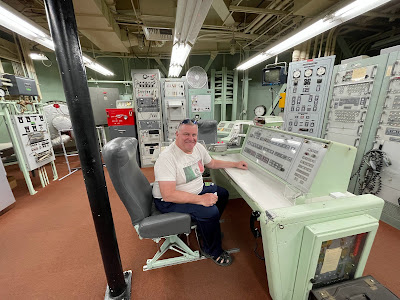
Commander K at the Control!
Titan Missile Museum
Sahuarita, Arizona

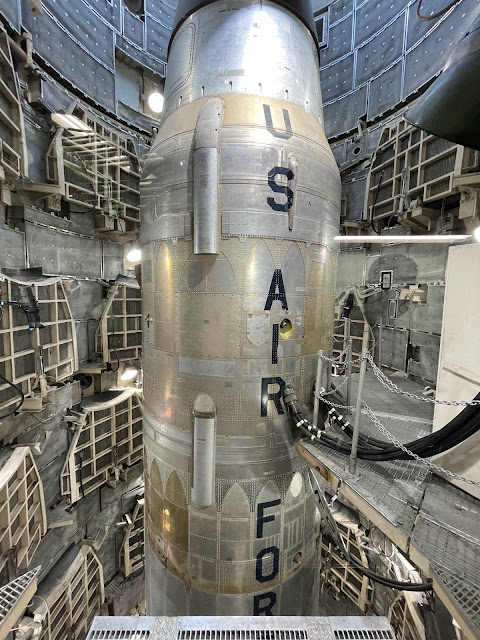
A visit to the Titan Missile Museum near Tucson Arizona demonstrates the hardware that created these Cold War certainties...https://titanmissilemuseum.org.  This abandoned missile silo for a Titan rocket was converted into a museum that gives us a glimpse into the Cold War.  The Strategic Air Command had Missile locations built in three states...Arizona, Kansas and Arkansas.


Titan Missile Museum
Sahuarita, Arizona

Very young men, and later women, manned these bases.  The Air Force tested them on a weekly basis for mental stability.  They worked underground in 24 hour shifts.  Cigarette smoke was ubiquitous.

The Titan missiles were fairly safe though one 1965 accident in Arkansas did claim fifty-three lives.  A welding rod was apparently tossed into a hydraulic line igniting a fire with the oxidizer.  Most of the victims were asphyxiated.

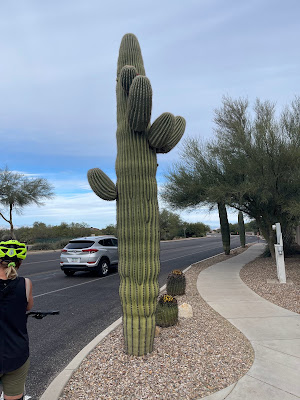
Don't High Five a Cactus!
Green Valley, AZ


Tom Lehrer got it essentially correct in his 1960 song The Wild West is Where I Want to Be.  "'Mid the yucca and the thistles, I'll watch the guided missiles while the old FBI watches me..."


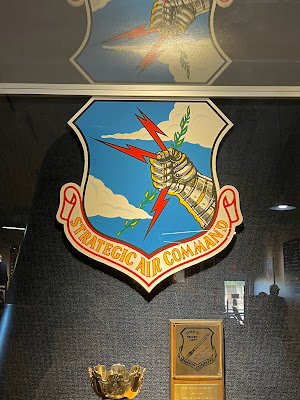
Strategic Air Command
Titan Missile Museum
Sahuarita, Arizona

Eventually the Titan missile program was replaced by the Minuteman ICBM Missile program.  The third iteration of Boeing-built missiles remain in active service in Montana, North Dakota and Wyoming.  Each missile can deliver a 300+ kiloton payload (equivalent to about 20 Hiroshimas) around 8,700 miles with an accuracy of around 800 feet.  These are slated for replacement by a new generation of Northrop ICBMs around 2030.

So the air in Arizona is no longer "radioactive," leaving the fortunate residents of nearby Green Valley safe to play pickle ball.  All of the fissionable materials were removed long ago from the Titan missile locations.  Many of these abandoned Titan sites have been purchased by private citizens.  A decommissioned site in Arkansas has been turned into a luxury Cold War hotel...https://www.expedia.com/Vilonia-Hotels-Luxury-Decommissioned-Titan-II-Nuclear-Missile-Complex.h53961576.Hotel-Information!


This may have been MAD but it all seemed to work.  The fear of Mutually Assured Destruction deterred both superpowers from ever pushing the nuclear button.  Nixon bombed Hanoi but he never authorized the use of atomic weapons.  Nor did the Soviets turn Kabul into glass.

Now in 2022 the Nuclear Club is much larger than during the Cold War.  It includes India, Pakistan, North Korea and soon it seems Iran.  Mutually Assured Destruction depended upon the rationality of the participants in order to work.  Can we count upon the rationality of Kim Jung Un and other leaders?  The future is murky and foreboding leaving us nostalgic for the Cold War. 

We live in an age on uncertainty.  Of this we are certain.


You can find signed copies of our books at these web sites...

!


Tuesday, January 11, 2022

Battle of Elwood

Commander K at Haskell's Beach
Goleta, California
Near Ritz Carlton Baccara

California, my home state, prides itself upon its peaceful laid back attitudes.  But California has not always been peaceful.  The state was, for example, fought over during the Mexican-American War.  The Battle of San Pascqual, fought near San Diego, featured the legendary frontiersman Kit Carson who walked some thirty miles in his bare feet to call for reinforcements.   I have written earlier invasions of California that have shaped the Golden state in numerous ways...https://www.blogger.com/blog/post/edit/4122629330054677829/6084681580602878101.

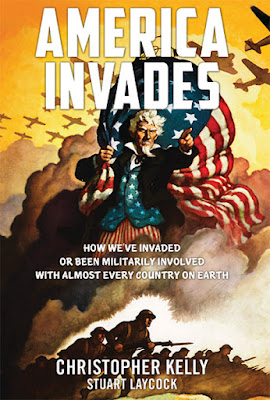
Many Californians seem to prefer to ignore the state's violent and colorful history.  But we must remember ALL history if we are to truly understand the past -- the good the bad and the ugly.  Everyone knows about the Japanese attack on Pearl Harbor on December 7, 1941 -- the 1942 Rose Bowl was played in North Carolina as a result!  But many would be astonished to learn that the beautiful California coastline was actually attacked during World War II.  The "Battle of Elwood" was fought almost eighty years ago near the town of Goleta.  This is what we had to say in the California chapter of America Invaded: A State by State Guide to Fighting on American Soil...

"On February 23, 1942, I-17 surfaced near Santa Barbara. The Japanese sub used her 140mm deck guns to shell the Ellwood oil refinery with sixteen to twenty-four rounds. Damage was minimal and no one was killed or injured in the attack, but Radio Tokyo crowed, “Sensible Americans know that the submarine shelling of the Pacific coast was a warning to the nation that the Paradise created by George Washington is on the verge of destruction.”

Battle of Elwood Plaque
Sandpiper Golf Club
Goleta, California

In the early morning hours of February 25, 1942, the air-raid sirens of Los Angeles sounded after an unknown aircraft triggered a blip on the radar. Anti-aircraft guns fired over ten tons of ordnance into the night sky. Eight citizens died during the “raid,” mostly due to heart attacks. The phantom raid had involved no Japanese planes. Panic had swept the West Coast. This incident later inspired Stephen Spielberg’s movie 1941." (Source: www.americainvaded.com).

Oil had been discovered in the Santa Barbara area in 1927.   An ARCO oil refinery was built in Goleta in 1938.  This was the target of the 1942 submarine bombardment.  In 1972 the site ws developed by Ken Hunter as the Sandpiper golf course.  In 2003 billionaire Ty Warner purchased Sandpiper Golf Club...https://www.sandpipergolf.com


Battle of Elwood Plaque
Sandpiper Golf Club
Goleta, California


A plaque by the clubhouse of the Sandpiper golf club reads: "Near this site at 7:07 PM February 23, 1942 the California coast at Elwood received the first naval bombardment of the United States mainland since the War of 1812..."

The bombardment of Elwood, eighty years later, may seem somewhat trivial.  But actions have consequences.  Though no one was killed or even injured by the bombardment, there were consequences.  This attack provided an excuse for media to whip up anti Japanese-American hysteria up and down the West coast.  The incident at Elwood contributed to the subsequent incarceration of thousands of Japanese American citizens in internment camps.   


Visitors to and residents of Santa Barbara can find signed copies of all four of my books at these fine independent book stores...

1) Tecolote Book Shop...https://www.tecolotebookshop.com

2) Chaucer's Books...https://www.chaucersbooks.com


You can find signed copies of our books at these web sites...

!


Tuesday, December 21, 2021

Graf Spee and Montevideo

Admiral Graf Spee
Maritime Museum of Montevideo


The Admiral Graf Spee was a German "pocket battleship" of ten thousand tons that was launched with considerable Nazi fanfare in 1936.  She was armed with six 11" guns in two triple gun turrets.  She was a fast ship capable of cruising at 28 knots.  Prior to the German invasion of Poland which commenced on September 1939 the Graf Spee was ordered to deploy to the South Atlantic.  With the outbreak of WW2 Captain Hans Langsdorff led her on a spree of destruction in the waters of the South Atlantic.  She sank nine merchant vessels accounting for a tonnage greater than 50,000.

Battle of River Plate Plaque
Maritime Museum of Montevideo

The Royal Navy responded by vectoring in three warships to confront the Graf Spee...the HMS Ajax, HMS Achilles (Royal New Zealand Navy) and HMS Exeter.  This intercepting fleet of cruisers was commanded by Commodore Henry Harwood.  Each of the three Allied ships was smaller and less formidably armed than the Graf Spee.  But Harwood relied upon superior numbers to take on the Graf Spee at the Battle of the River Plate which was fought on December 13, 1939.  

Anchor of HMS Ajax
Punta del Este, Uruguay

The battle was inconclusive.  The Graf Spee inflicted damage on the three Allied ships but was also damaged herself.  Captain Langsdorff was wounded twice by splinters while standing at the bridge.  The Graf Spee was forced to retreat to the Uruguayan capital of Montevideo where Langsdorff requested two weeks time to make repairs to the ship.  Uruguay, a neutral nation, only permitted the Graf Spee 72 hours to repair the vessel.

Adolph Hitler Plaque
From Graf Spee
Maritime Museum Montevideo

Langsdorff believed, mistakenly, that more than three Allied ships lay in wait to intercept the Graf Spee if it should leave Montevideo.  He decided that a second Battle of the River Plate was not worth the risk.  He chose to scuttle his ship on December 17 outside Montevideo harbor.  He then proceeded to Buenos Aires where he blew his brains out in a hotel room while lying in the ship's ensign.  Many German sailors and officers, stranded in Uruguay, made their way to Argentina for the duration of the war.  Artifacts from the wreck of the Graf Spee have been recovered over the years since.  Many were sold to collectors.  A few can be found at the Maritime Museum of Montevideo...http://www.histarmar.com.ar/Museos/MuseoNavalMontevideo.htm.

Churchill heartily congratulates sailors of the HMS Ajax
who vanquished the Graf Spee

Winston Churchill, head of the admiralty in December 1939, celebrated the Allied victory over the Graf Spee with gusto.  Churchill knew that Harwood and the British had essentially bamboozled Langsdorff into overestimating Allied naval strength in the South 'Atlantic.  Had the Graf Spee chosen to challenge the Allied blockade of Montevideo she could, perhaps, have damaged a British cruiser and escaped to wreak more havoc upon Allied merchant shipping.

Falklands War
1982

The legacy of the victory over the Graf Spee lives on.  The Royal Navy, the nation's senior service, has had a proud winning tradition from Drake to Nelson.  In 1982 the Royal Navy would be tested again when the Argentine Junta invaded the Falklands islands.  Thatcher dispatched a Royal Navy fleet 8,000 nautical miles to the South Atlantic to liberate them from Argentine control.  The United States remained officially neutral but Reagan helped to provide fuel, ammunition and intelligence in the campaign.  The Argentine Cruiser Belgrano was torpedoed and sunk on May 2, 1982 by HMS Conqueror costing 323 lives.  The Belgrano has originally been the USS Phoenix -- a Brooklyn class cruiser in the US Navy.  She was a veteran of Pearl Harbor and had once served as MacArthur's flagship.

Sinking of Belgrano

Tourist Notes: The Maritime Museum of Montevideo is a small but excellent institution which preserves Uruguayan naval history...http://www.histarmar.com.ar/Museos/MuseoNavalMontevideo.htm.  They even have a cannon from the HMS Agamemnon that was captained by Horatio Nelson.  

Cannon from HMS Agamemnon
Maritime Museum of Montevideo

Many of the Uruguayan wines are delicious.  I particularly enjoyed the Tannat Reserve produced by Bodega Garzon...https://bodegagarzon.com/en/wine/reserva-tannat-2016/.

Finally, when you visit Uruguay's capital don't forget to bring some quarters -- in order to play the Montevideo games!


You can find signed copies of our books at these web sites...

!


Wednesday, December 1, 2021

Invading Madeira

Commander K
"Invading" Madeira 2021


Madeira is a small but beautiful island off the coast of West Africa.  It is a hilly mountain rising up from the sea.  A fertile garden archipelago surrounded by blue.


Henry the Navigator
1394 - 1460
Funchal, Madeira

The Greek philosopher Plutarch described two islands off the coast of Africa as being the isles of the Blessed.  There is some evidence that Vikings may have visited these islands.  But it was really two Portuguese captains who officially discovered these islands in 1418.  One of these, João Gonçalves Zarco, was appointed first captain of Funchal by Henry the Navigator (1394 - 1460).  Henry was the prime mover behind the Portuguese era of exploration.  Under his leadership, the Portuguese began to colonize Madeira after 1420.  Funchal remains the capital of the Madeira archipelago.

João Gonçalves Zarco
1390 - 1471

In 1617 Barbary corsairs from North Africa raided Porto Santo and captured around 1,200 people.  During this period the Barbary pirates were raiding throughout the Mediterranean and as far as Ireland.

USS Constitution vs HMS Java
Geoff Hunt (Author's collection)
She was christened with Madeira wine

Madeira is famous for its sweet wine that has been produced for centuries.  Thomas Jefferson was a fan of madeira wine.  The USS Constitution was christened in 1797 with a bottle of madeira.  The fortified wine was immortalized in the ribald Flanders and Swann song Have Some Madeira M'Dear...


Lying near the equator the island was fertile and suitable for growing sugar cane.  Slave labor from Africa was utilized in the sugar plantations.


In 2012 my coauthor, Stuart Laycock, wrote a book called All the Countries We've Invaded...And the Few We haven't gotten around to (https://www.amazon.com/All-Countries-Weve-Ever-Invaded/dp/0750952121/ref=sr_1_1?crid=1ELTYR1LS8YWE&keywords=all+the+countries+we%27ve+ever+invaded&qid=1638388447&sprefix=all+the+countries+%2Caps%2C1515&sr=8-1).  He describes how the British have invaded or fought in 90% of all the countries in the world.  The British invaded Madeira as well.  In 1801 they first occupied occupied Madeira.  The left in 1802 in accordance with the Peace of Amiens only to reoccupy the island in 1807.  They held onto the island until the end of the Peninsular War when they returned control of the island to their Portuguese ally.  

Churchill in Funchal

Winston Churchill was fond of Madeira.  He, like so many other tourists, arrived in Funchal in January 1950 from a cruise liner -- the Durban Castle.   He and Clemmie stayed at Reid's hotel which has recently reopened after a brief closure due to the Covid-19 pandemic (https://www.belmond.com/hotels/europe/portugal/madeira/belmond-reids-palace/).  Churchill enjoyed painting the islands' scenic landscapes.

In March of 1916 Imperial Germany declared war on Portugal in World War I.  As a result, war came to the normally peaceful Madeira islands later that year on New Year's Eve, 1916 when a German U-boat crept into Funchal harbor and sank one British and two French vessels.  The aggressive German sub rose to the surface and proceeded to bombard Funchal with its deck guns.  Three residents were killed in the attack which lasted about two hours before the U-boat was driven off by shore batteries.

Karl I, the last emperor of Austria Hungary was exiled to Madeira after World War I.  The last Hapsburg monarch died of bronchitis at age 34 and is buried at the church of Our Lady of the Mount in Madeira. The assassination of his older brother, Franz Joseph, in Sarajevo in June of 1914 was the even that triggered the start of World War I.  My great grandfather, Thomas Tileston Wells, was crossing the Atlantic to Europe with his wife and family at the time of the assassination (www.anadventurein1914.com).

Funchal
Madeira

In 2019 about 1 1/2 million tourists visited the Madeira archipelago which compares with a local population of about a 1/4 million.  Tourism accounts for about 20% of the local economy.  

Commander K says by all means, "Have some Madeira, M'dears!"


Viking Jupiter
Funchal, Madeira

Tourist Notes: I had the pleasure of visiting Madeira in November 2021 while sailing with the Viking Jupiter from Barcelona to Buenos Aires.  Viking is an excellent Cruise line...https://www.vikingcruises.com


You can find signed copies of our books at these web sites...

!


Saturday, November 27, 2021

Mission: Jimmy Stewart and the Fight for Europe

 
Jimmy Stewart
1908 - 1997


Robert Matzen's Mission: Jimmy Stewart and the Fight for Europe was published in 2016 (https://www.amazon.com/Mission-Jimmy-Stewart-Fight-Europe/dp/173227357X/ref=tmm_pap_swatch_0?_encoding=UTF8&qid=1638016209&sr=8-1).  Jimmy Stewart was a remarkable American actor and a remarkable man as well.  Stewart's family had a strong military tradition.  His grandfather, the original James Stewart, served in the Union army in the US Civil War with Phil Sheridan.  His father, Alex, had served as a doughboy in the American Expeditionary forces in WWI.

Jimmy Stewart seemed to be on an altogether different life path.  He attended Princeton University where he participated in theatrical programs.  He became a close friend of Henry Fonda.  This Pennsylvania native moved west to Hollywood to pursue a career in film acting.  Stewart shot to the top of his profession.  In 1941 he won an academy award for best actor for his role in The Philadelphia Story.

But the drumbeat of war did not escape the attention of Stewart who had trained as a pilot in preparation for war.  In March of 1941, months before the attack on Pearl Harbor, Stewart received an ORDER TO REPORT FOR INDUCTION as a US Army reservist.  Though he was 33 years old in 1941 and considerably older that his peers in U.S. Army Air Corps but Stewart was determined to become an active duty pilot.  He even defied the wishes of his studio boss Louis B. Mayer who had hoped to keep Stewart safe and stateside making propaganda pictures during the war.  

B-24 Liberator Stained Glass
National Museum of the Mighty 8th Air Force
Pooler, GA

Stewart was training at Moffett Field in California when the Japanese attacked Pearl Harbor.  He later trained at Gowen Field in Idaho and Kirkland Field in New Mexico.

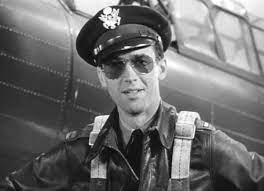
After his training, Stewart was posted to Tibenham in East Anglia in the UK.  Stewart piloted a B-24 Liberator bomber in the 445th Bomb Group of the "Mighty" 8th Army Air Force.  The B-24 was a notoriously difficult plane to fly.  Stewart mastered the tricky plane and flew in twenty combat missions over Nazi occupied Europe.  He served as a chief of staff for missions that bombed targets in occupied France prior to the Normandy invasion in June 1944.  Nor did he seek publicity for his wartime service while in the military.

Flying daylight bombing missions was incredibly hazardous.  The Germans sent up a cloud to flak from their AA guns positioned all over occupied Europe.  Luftwaffe pilots were usually experienced and well equipped.  The Fock Wolf 190 was a fast and capable interceptor.  The final stages of the war saw the introduction of German jet fighters such as ME-262 that could reach speeds of 515 mph.  Stewart's final mission involved bombing a jet fighter factory near Achmer.  

In addition to enemy action, simply flying the Liberator in formation could be extremely hazardous.  Accidents cost many lives in the course of the war.  The Sunflower Sue, for example, was lost with its crew of ten and four passengers while flying over the Caribbean en route from Puerto Rico to British Guyana.

Colonel Stewart
445th Bomber Wing

 Jimmy Stewart earned the silver eagles of a full colonel.  In that capacity he wrote many condolence letters to the families of downed airmen.

After the war was over and Stewart was discharged he refused to talk to the press about his wartime experiences.  He never sought to profit from his war service in any way.  He continued to serve in the reserve.  During the Vietnam War he rose to the rank of Brigadier General in the US Air Force.  He flew on a B-52 mission over Vietnam as an observer.


In 1946 Stewart starred as George Bailey in Frank Capra's It's a Wonderful Life.  Ironically, Bailey, despite his severe wanderlust, stayed home and built up the Building and Loan while his brother went off to war.  The film received scant attention at the time but went on to become a Christmas classic.  Stewart had been a witness to the full horrors of war and these experiences unquestionably deepened and informed his acting. Matzen's book barely mentions the incredible work that Stewart did with Alfred Hitchcock in Vertigo and Rear Window. But these dark haunting performances would have been unthinkable without Stewart's searing experience in WW2.

Matzen's book is not a balanced biography of Jimmy Stewart.  Clearly it focuses on Stewart's years of service in WW2.  It barely touches on his post war acting career or his marriage to Gloria Hatrick McLean.   Jimmy was a stepfather to Gloria's two sons.  The couple also had two daughters.  His stepson, Ronald McLean, was killed in 1969 Vietnam while serving as a Marine officer.  President Reagan promoted Stewart to the rank of Major General.

Matzen unaccountably neglects to mention that Walter Matthau (1920 - 2000) also served in the 453rd Bomber Group as a radioman-gunner.  But these are minor quibbles as Matzen's Mission is a Wonderful story about a truly Wonderful Life. 

National Museum of the Mighty Eighth Air Force
Pooler, Georgia

Tourist Notes: Commander K. highly recommends a visit to the National Museum of the Mighty Eighth Air Force in Pooler, Georgia... https://www.mightyeighth.org


You can find signed copies of our books at these web sites...

!


Sunday, November 7, 2021

The General vs. The President


H.W. Brand's 2017 The General vs the President is a timely re-examination of the Truman / MacArthur confrontation that roiled the world at the outset of the Cold War (www.amzn.com/0385540574).

MacArthur was no ordinary General.  He and his father were the only father / son team awarded a Medal of Honor in US history.  MacArthur was no intellectual lightweight -- he "ranked first in his class three out of his four years" at West Point.  He earned many medals for conspicuous bravery while fighting on the Western Front in World War I.  He accompanied French troops on trench raids to capture German troops behind enemy lines.  MacArthur was smart and he was brave.

That does not mean that he did no make his share of mistakes over a long and distinguished military career.  In the Philippines he allowed American planes to be destroyed on the ground immediately following the Japanese attack on Pearl Harbor.  This inexcusably and unnecessarily crippled the Philippine air defense.   He miscalculated the determination of the Japanese to hold on to Manila (see my review of Rampage...https://www.blogger.com/blog/post/edit/4122629330054677829/5794492647359096591). Korean War MacArthur badly underestimated the will and strength of the Communist Chinese.

Douglas MacArthur
1880 - 1964


But these failings should not prevent us from appreciating MacArthur's unique place in the panoply of American military figures.  MacArthur vowed that, "I shall return" to the Philippines; and return he did.  Winston Churchill declared, "Of all the amazing deeds of bravery of the war, I regard MacArthur's personal landing at Atsugo as the greatest of the lot."  MacArthur found the perfect tone when, on the deck of the USS Missouri, accepting the Japanese surrender he said, "It is my earnest hope, and indeed the hope of all mankind, that from this solemn occasion a better world shall emerge out of the blood and carnage of the past -- a world founded upon faith and understanding, a world dedicated to the dignity of man and the fulfillment of his most cherished wish; for freedom, tolerance and justice."  MacArthur proved to be a remarkably successful Pro-consul for occupied Japan -- where he introduced women to the ballot box.

Brand notes that "the North Korean attack on South Korea took Douglas MacArthur quite by surprise."  But MacArthur seemed quickly to rise to the Communist challenge.  When South Korean and American forces were surrounded inside a narrow perimeter near the port of Pusan MacArthur plotted the United Nations' daring counterstroke at Inchon.  The amphibious invasion at Inchon turned the Communist flank, quickly liberated Seoul and was, perhaps, the most brilliant American use of military power of the post war era.  By December 1951 the North Korean capital, Pyongyang, was in the hands of UN forces.  Bob Hope held a celebration for the US GI's there.

But it was MacArthur's success led to his fatal hubris.  He dismissed reports of Chinese Communist forces massing north of the Yalu River.  Human wave assaults and massive numbers hit UN forces and drove them backwards towards the 38th parallel.

Harry S Truman
1884 - 1972


Appearances to the contrary, Harry Truman was no ordinary president.  He had served with honor in the artillery during World War I.  Brand neglects to mention that MacArthur, as head of the Rainbow division was, in fact, Truman's immediate boss during World War I.  Truman was largely an autodidact.  He read widely and he developed a reputation for incorruptibly despite his association with the Pendergast machine of Kansas City.  An ailing FDR chose him to be his Vice President in 1944. 

Though Vice President Truman had been told nothing about the atomic bomb prior to the death of FDR in 1945, he made the difficult but correct decision to use this tool to end Japanese resistance at the close of World War II.  He dropped bombs on Hiroshima and Nagasaki that killed over a hundred thousand people including most of whom were civilians.  Truman boasted that he "never lost any sleep" over these decisions. (I would submit that had Truman not unleashed the horror of atomic warfare in 1945, there is a high degree of probability that the US or SOME OTHER NATION would have utilized a future iteration of atomic power causing far more more deaths including perhaps the start of World War III.)

Rainbow Division WW1
MacArthur was Truman's boss first!


Truman and MacArthur collided when MacArthur veered out of his lane on account of his soaring political ambitions.  MacArthur saw himself, not merely as a hugely successful American field commander but also as a near Messianic savior against godless Communism.  MacArthur was very good in his perceptions of the working of the Oriental mind.  But he was very weak in his appreciation for the dynamics of domestic American politics.  Fatally, MacArthur disregarded the chain of command.  He made obtuse comments to the press and sympathetic veterans' groups.  At the end of the day, Truman was Commander in chief.  He had a constitutional duty to be the final arbiter of American foreign and military policy.

The Korean War degenerated into a brutal grinding stalemate along the 38th parallel.  Neither side could win.  America lost over 36,000 killed and far more wounded over the course of about three years.  The Republic of Korea and many other UN nations suffered as well.

Truman, like MacArthur, made a number of grave miscalculations in Cold War strategy.   Brand fails to point out several of Truman's blunders...1) that Truman abolished the OSS (Office of Strategic Services) mainly on account of his distaste for "Wild Bill" Donovan.  The CIA would have to be rebuilt from scratch starting in 1947.  2) Truman, bowing to domestic pressure, proceeded with a rapid and steep demobilization of US military forces following the conclusion of WW2.  American military power was not just trimmed but cut to the bone.  This gravely weakened US military capabilities prior to the outbreak of the Korean War.  These vulnerabilities would be exploited by the Communist forces.

Truman's firing of MacArthur is widely approved of by Brand and many other commentators.  But Truman COULD have run for re-election in 1952.  His treatment of MacArthur made him hugely unpopular at the time and led to his decision to not seek a second elected term.  As Brand accurately notes, "Truman's bold stroke in firing MacArthur ended his own career as surely as it terminated MacArthur's."

Dwight Eisenhower
1890 - 1969


In the end the American electorate got it right.  1952 and the crisis of the Korean War called for an experienced military leader at the helm.  But that leader was Eisenhower and not MacArthur or Truman.   Ike, the architect of D-Day, had a broader global perspective and greater diplomatic skills than either MacArthur or Truman.

Truman and his minions painted MacArthur's stated threat to use atomic weapons against the Chinese as sheer lunacy.  Yet it was precisely this same veiled threat, delivered by Ike through Indian intermediaries, that ultimately led to the fragile peace in Korea that endures to this day.

Finally, Brand's flawed but worthwhile book has a curious relevance to our 21st century.  In 2021 we seem to have experienced a "MacArthur moment" when General Mark Milley defied the orders of a duly elected president by undermining his policy in regard to China.